The MAP sensor, or Manifold Absolute Pressure sensor, is the main part of the turbocharged engine system that offers temperature and pressure measurements for getting important data for getting details of the engine’s working. A temp sensor with measuring engine intake air pressure, which also measures intake air temperature.
It is an important component for providing high engine fuel efficiency and reducing emissions as well, with optimized working. In this tutorial, we will cover detailed features of the TAMP sensor and related features, so let’s get started.
What is a TMAP Sensor?
- The TMAP sensor is an engine control sensor; it provides the functions of two distinct sensors in one unit. The first is the map sensor, which measures air pressure in the intake manifold of the engine.
- The second component is a temperature sensor that measures the temperature of the air coming into the manifold.
- These two sensors, working in one unit provide compact, low-cost wiring in the car.
- Turbocharged engines come with high efficiency and performance, and the TMAP sensor part of the engine means the ECM provides accurate fuel mixture settings, ignition control, and exhaust gas recirculation for engine performance optimizations.
- This sensor helps the ECM to provide accurate fuel injection and ignition control with proper intake air pressure and temperature values.
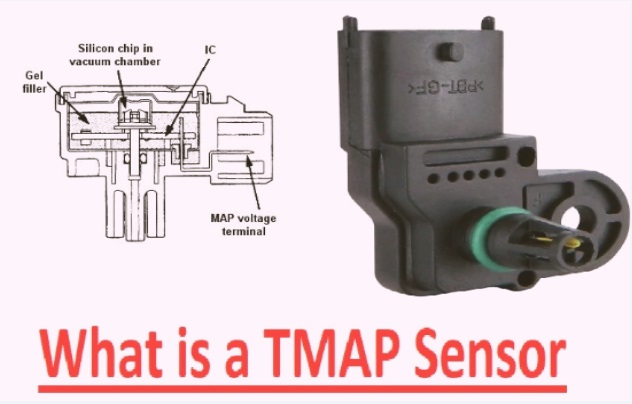
TMAP Sensor Working
The MAP sensor works through 2 main factors of intake air; the first one is temperature, and the second is pressure. These details are delivered to the Engine Control Unit (ECU). The steps involved for the working of the TMAP sensors are the following:
MAP Function
- The sensor comes with a diaphragm made of silicon with strain gauges or piezoresistive components. The diagram shows that the flexes with air pressures of the intake manifold vary. That flexing changes sensor resistance and transforms into voltage with direct proportionality to manifold pressure.
IAT Function:
- • The sensor also has a thermistor, which is a temperature-sensitive resistor. With an increase in intake air temperature, resistance reduces; when it cools, resistance increases.
- ECU translates resistance variations into a temperature reading.
Signal Transmitted to the ECU:
- The TMAP sensor transmits pressure and temperature data in the form of electrical signals, and the ECU works on these factors for measuring air density.
ECU control according to TMAP data:
- Air-fuel ratio, offering an accurate mixture for effective combustion. Igniting timing control knocking by controlling spark timing.
- With turbo boost control, in supercharged engines, the ECU manages boost pressure to prevent overboosting.
- It also offers emission controls, provides compliance with emission standards, and offers combustion control.
TMAP Sensor Features
The TMAP sensor’s main features are
- Data from the TMAP sensor engine computer combines pressure and temperature values for measuring the density of air added to the engine. Denser air uses more fuel for combustion, which is helpful for fuel injection.
- According to air-density values, ECU defines accurate times for fuel injectors. That process is called pulse width. If the TMAP sensor shows high-pressure, dense air, the ECU instructs a longer pulse width to add more fuel. For a low-pressure air sensor, instruct a short pulse width for less fuel injection.
- TMAP sensor computer control for spark plug timing. Ignition timing provides high power efficiency. For high engine load, spark is required to be delayed to control conditions like pinging. Temp measurements instruct the ECU to make these adjustments.
- • The sensor also boosts pressure for turbo/supercharged engines, which increases car performance. For supercharged engines, TMAP sensors provide boost pressure control. It indicates the pressure required for the engine. ECU works on this data for regulating the blow-off valve. that provides the needed boost without damage from overpressurization, so TMAP is called the boost pressure sensor.
- TMAP also provides EGR system function monitoring since EGR reduces emissions. The temp sensor detects variations of manifold pressure during EGR valve opening.
Difference Between MAP Sensor and TMAP Sensor
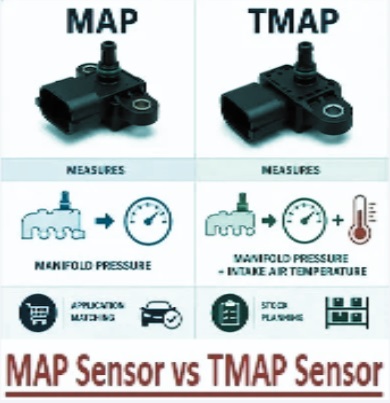
MAP (Manifold Absolute Pressure) sensors and TMAP are important components of engine control systems. Either they look the same but have some differences. Their main differences are mentioned here.
Working
- Map sensor function is to measure absolute pressures air pressure of the intake manifold. It comes with sensing components like silicon-based components for the detection of engine intake air. Through these calculations, the pressure data given to the engine control unit is helpful for calculating the air added to the cylinder.
- A MAP sensor with measuring pressure also detects intake air temperature. Temperature varies air density, so this dual measurement provides a correct measurement of volume and air density. With these calculations, the ECU offers accurate fuel injection and ignition timing to optimise engine function.
installation point
- The MAP sensor is normally located on the intake manifold. It puts direct pressure of air through the intake manifold.
- The temp sensor is also connected to the intake manifold, but close to the turbocharger outlet. This connection easily gets pressure and temperature variations by providing real-time data.
Operations
- Map sensor operation to transform measured air into an electric signal and send it to ECU. with checking data for ECU and engine speed, required fuel amount taken, and injection timing for the required air-fuel ratio.
- TMAP sensors also provide more detailed, thorough temperature variation monitoring. That helps ECU consider the temperature effect on air pressure. Low-temperature air, which has high density, uses more fuel for high combustion efficiency.
Temperature management
- • The map sensor does not have temperature-managing features and shows pressure variations. An abrupt variation of ambient temperature is a result of changes in ECU values.
- The TMAP sensor comes with built-in temperature-sensing features for managing air density variations resulting from temperature changes. That offer of ECU-correct data helps the engine to work well in external temperatures.
Where TMAP Sensor located
Tmap sensor installation based on engine and vehicle types. Such an engine is turbocharged and naturally aspirated. In some conditions, it’s a location where it’s easy to measure air pressure and air temperature for the intake system. Normally, it’s connected.
- It connected on or close to the manifold. For forced induction engines, a temp sensor exists in the charge pipe close to the intercooler.
- In some vehicles, a TMAP sensor exists close to the throttle body. In some designs, the TMAP is configured with a manifold and other sensors.
How to find a T-map location
- Follow these steps.
- Check the repair manual; that is the best option and comes with pictorial representation.
- Check the intake manifold; check the small sensor with an electrical connector.
Faulty TMAP Sensor Symptoms
A failing temp sensor delivers faulty data to the engine computer. The resulting computer is a bad result for Spark and Fuel, causing different faults. Some common signs are
Check Engine Light is On
engine computer regularly performs self-testing. If the tmap sensor signal is not in the required value range, ecu become on the check engine light and store dtc code. main codes related to Tmap sensor are
| DTC Code | Details |
| P0105 | MAP Sensor Circuit Malfunction |
| P0106 | MAP Sensor Performance faults |
| P0107 | MAP Sensor Circuit Low Voltage |
| P0108 | MAP Sensor Circuit High Voltage |
| P0112 | Intake Air Temperature Sensor Circuit Low Voltage |
| P0113 | Intake Air Temperature Sensor Circuit High Voltage |
Bad fuel efficiency
- If the temp sensor shows a lower pressure reading compared to the required pressure value. The ECU shows the engine facing a light load.
- It will add less fuel compared to the required amount. It looks preferred for proper fuel efficiency, so the case has a bad effect.
- engine lean conditions resulting in power reduction. So press the gas pedal for speed maintenance when high fuel is used.
Engine faults
- • The car faces difficulty during acceleration and also faces a jerk when the gas pedal is pressed.
- Rough idling occurs; the engine vibrates when stopped.
- • The engine can stall when stopped since the ECU does not give accurate fuel during idle.
Engine Knocking
- If the temp sensor is showing high pressure when the real pressure is low, the ECU adds a high fuel quantity. It causes a high mixture that causes ignition timing to be off.
- These conditions result in an engine knocking or rattling sound when the engine accelerates. An engine knock is not good; it causes engine damage.
Exhaust smoke
- High-pressure sensor values cause a high air-fuel mixture. So fuel in the engine is not completely burned. Unburned fuel is released in the exhaust system, and ignition occurs in the catalytic converter, releasing like black fumes.
Turbocharged engine faults
- For turbo vehicles, a faulty boost pressure sensor results in serious errors. Turbo does not generate boost or causes high boost. As a result, faulty damage occurs.
Main Causes of Faulty TMAP Sensor
Different factors like heat, pressure, and airflow affect temperature, which causes faults. Some common causes for temperature sensors are
faulty electrical connector
- Damaged, loose, or corroded wiring and connectors affect the signal between the sensor and the ECU.
Contamination
- Oil vapors of the crankcase ventilation system and dust of the intake system accumulate over the sensor, causing faulty values.
Heat affects
- The high temperature of turbocharged engines badly affects sensor components.
Moisture
- facing condensation, leakage of coolant, or water ingress as a result of corrosion
Damage
- Faulty handling and installation cause sensor casing damage.
Aging
- In some parts, sensors slowly fail for longer uses and degradation of components.
ECU or Voltage Supply faults
- In some conditions, the main fault is not the sensor but a faulty voltage supply that does not accurately define sensor signals.
TMAP Sensor testing method
- The temp sensor is important for that, causing engine operation errors. Test with applications of the digital multimeter and the OBD-II scanner. Different testing methods are
Visual Inspection
- First, find the temp sensor check connector to determine if it is accurately connected or not.
- If the sensor comes with a small vacuum hose, find the hose and ensure it is not damaged or disconnected.
- Disconnect the sensor on the intake manifold check port. Cleaning a port helps to solve errors.
OBD-II scanners use
- Connect OBD-II scanner and check stored fault codes. that are
| DTC Code | Details |
| P0106 | MAP/Barometric Pressure Circuit Range/Performance faults |
| P0107 | MAP Sensor Circuit Low Voltage |
| P0108 | MAP Sensor Circuit High Voltage |
- Apply the tool for checking data of the MAP sensor and the engine when it is stopped.
- Through the idling engine, the map sensor values are low, like in the range of 1.0 and 2.0 volts or 10-20 inHg.
- Click the gas pedal, and left voltage or pressure values increase fast and again reach the required conditions. A slow response shows a bad sensor.
- Note intake air temperature values. It is close to the ambient air temperature value. It is close to ambient air temperature when the engine is in cold conditions.
Multimeter use
Follow these steps for a multimeter.
Reference voltage measurement
- First, disconnect the sensor connector and set the metre at the DC voltage range. Connect the connector reference wire and ground and find that the reading value is five volts.
Ground checking
- Connect the single probe over the sensor ground point and the 2nd on the battery negative point. There must be continuity about zero.
Output signal testing
- make sensor reconnection with an ignition back probe of signal wiring.
- For atmospheric pressure check 4.5 to 5 V on seal level. With the engine starting, when vacuum increases, voltage losses reduce to one to two volts for idle conditions.
- Now during engine revving, voltage increases with pressure increases.
Intake Air Temperature
- Set the multimeter to a resistance value. Calculate resistance over IAT pinout. For room temperature, resistance is 2–3 kΩ. Resistance reduces when temperature increases.
Replacing method of TMAP Sensor
Follow these steps.
- First, separate the negative battery cable, then locate the TMAP sensor on the intake manifold.
- Disconnect the connector with a clip click and remove it.
- Disconnect one or two bolts and pull the sensor from the port.
- Now connect the new sensor on the port; if there is an O-ring, use clean engine oil for sealing.
- Reconnect and secure bolts, but do not overtighten since the sensor casing is plastic and has damage chances.
- Reconnect the connector and click it; reconnect the battery’s negative cable.
- With a scan tool, check the engine light and fault codes; take a test drive of the car to confirm that fault removed
Difference between TMAP and UMAP
| Feature | TMAP | UMAP |
| Full Name | Tree MAP | Uniform Manifold Approximation and Projection |
| Purpose | very large high-dimensional datasets visulaization using a tree structure | Dimensionality reduction and visualization |
| Output Structure | Tree/graph layout | Continuous 2D or 3D embedding |
| Best For | Huge datasets, chemical libraries, bioinformatics, and sparse data | machine learning, clustering, and embeddings |
| Preserves | Global relationships and nearest-neighbor topology | Local structure , with some global structure |
| Scalability | scalable to millions of points | Scales well, but can become slow on high datasets |
| Speed | Very fast for large datasets | Fast, but slower than TMAP at extreme scale |
| Memory Usage | Low memory uses for large sparse datasets | Higher memory usage comparatively |
| Visual | Branch-like tree map | Cloud/scatter plot style |
| Deterministic | stable/deterministic in many cases | vary between runs unless random seed fixed |
| Underlying Idea | Locality-sensitive hashing + kNN graph + minimum spanning tree | Manifold learning + fuzzy topological graph optimization |
| Common Applications | Chemical space mapping, genomics, document datasets | NLP embeddings, image data, clustering visualization |
| Handles Sparse Data | Excellent | Good |
| Inter-cluster Separation | Often very interpretable | visually appealing and smooth |
| Dimensionality Reduction Use | visualization-focused | both for visualization and preprocessing |
| Compared to t-SNE | scalable and preserves connectivity | Faster and high structure-preserving than t-SNE |
Conclusion
Through the correct intake air temperature and pressure, the TMAP sensor helps the ECM with the proper regulation of engine working conditions with optimised fuel usage and increased efficiency. It does not provide power and efficiency but also works for environmental protection by making vehicles follow emission parameters. Through proper use of hybrid and EV techniques, the use of sensors is becoming common, showing that using a TMAP sensor for vehicles is the main factor.
Frequently Asked Questions
Why is the TMAP sensor used?
- TMAP sensors give data on engine intake pressure and temperature that helps the ECM to set different factors, ignition timing, fuel injection, and exhaust gas recirculation.
- that accurate tuning makes high-efficiency engines, optimizes fuel, and minimizes emissions so accurate engine functioning occurs
Where is the TMAP sensor located?
- It is located in the intake manifold, between the air filter and the engine, and gets air from the outside towards the engine. Its exact location can differ according to the model; normally, it exists close to the turbocharger since it offers accurate temperature and pressure of air when it is pressurized.
What is the main difference between a TMAP sensor and a MAP sensor?
- Working of the manifold absolute pressure sensor to calculate pressure in the intake manifold. The MAP sensor measures intake air pressure for correct pressure data. Temperature data is proper for the ECM to measure air density since density changes with temperature.
How to locate the TMAP sensor on a BMW 550?
- The TMAP sensor BMW 550 is located on the lower part of the engine, below the engine casing. The vehicle manual offers accurate locations or diagnostic tools used for finding wiring sensors.
How to change the TMAP sensor on an R53?
- Disconnect the battery’s negative pin and take some time. After that, disconnect the sensor harness and fix the bolts, and disconnect the old sensor. When connecting the new sensor, secure the bolts and make the connection of the harness.
- In the last, again, connect the battery negative pin.
Is it possible to clean a TMAP sensor?
- Yes, we can clean the temp sensor through disconnection and with a proper sensor cleaner. So, softly clean the probe through a soft cloth to prevent damage. Before cleaning the clean sensor
What is the full form of TMAP?
- TMAP is a temperature and manifold absolute pressure sensor. that calculates intake air temperature and pressure for good engine working and fuel efficiency
How to use tMap?
- The MAP sensor calculates intake air pressure with temperature and transmits a signal to the ECM. The ECM employs signals for setting fuel injection quantity and ignition timing for proper engine control.