Electrical wiring is an important part of electrical systems, and before using wires in circuits, different factors are considered. The most important factor is wire ampacity, which shows how much current the wire can carry. 6 AWG wire is also important for different applications, especially where heavy loads exist, and for EV chargers. In this tutorial, we will cover features for 6-AWG wire ampacity and different types. So let’s get started.
How Much Current Can 6 Gauge Wire carry?
6 AWG wire ampacity is based on conductor material, installation techniques, and insulation. Normally, 6 AWG wire carries current in the range of 40 amperes to 75 amperes.
But ampacity can be different according to the materials used for wire, such as aluminum, copper, etc.
Let’s discuss each material’s 6 AWG wire ampacity.
6 AWG copper ampacity
- Copper is a commonly used conductor material for different wire installations. That is the best current conductor with high durability.
- 6 AWG copper wire normally has an ampacity of about 75 amperes according to temperature. But according to rated temperaure of wire insulation value and different.
- Normally, the rated temperatures are 60°C, 75°C, and 90°C. These values define high temperatures that the wires carry without affecting insulation.
- normally
- 6 AWG copper wire installations ampacity factors areas are
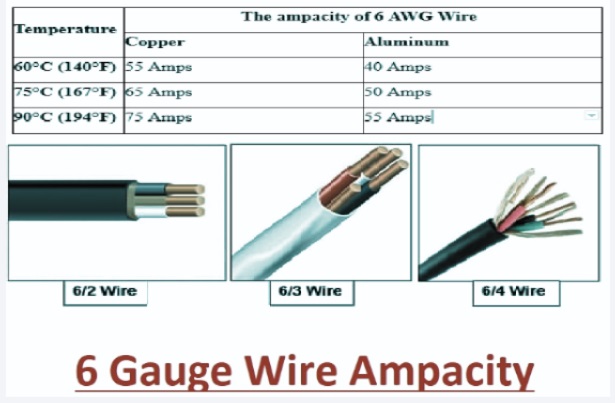
Temperature Rating | Current Capacity |
| 60°C | 55 A |
| 75°C | 65 A |
| 90°C | 75 A |
- Insulation’s high temperature rating causes the wire to manage high heat, resulting in current, in other words, a current.
- Mostly circuit breakers and outlets, according to the terminal rating, work for 75 degrees.
- For a 90-degree wire, use a circuit breaker having 75-degree ampacity.
6 AWG Aluminum Wire ampacity
- Aluminum wire has less electrical ampacity than copper wires since it offers low conductivity. But aluminum wire is a lighter and more viable option than copper. that is used in industries for longer-distance transmission as a low-cost option
- A high-temperature rating of wire insulation causes high ampacity. Through using 90-degree-rated insulation, we get 15 amps more than 60-degree-rated insulation.
- Practically, 6 AWG aluminum ampacity range is 40 to 50 amps. Those values are based on temperature and installation conditions that determine ampacity values.
- Based on NEC guidelines 6awg aluminum wire ampacity is
| Conductor Size | Material | Insulation Temperature Rating | Example Insulation Types | Ampacity |
| 6 AWG | Aluminum | 60°C | TW, UF | 40 A |
| 6 AWG | Aluminum | 75°C | RHW, THHW, THWN | 50 A |
| 6 AWG | Aluminum | 90°C | THHN, XHHW | 55 A |
6 Gauge Wire: Copper vs. Aluminum Conductors
| Feature | 6 AWG Copper | 6 AWG Aluminum |
| Ampacity | 55A 60°C 65A 75°C 75A 90°C | 40A 60°C 50A 75°C |
| Conductivity | Higher | Lower |
| Heat Resistance | Excellent | Moderate |
| Weight | Heavy | lighter |
| Cost | High | cheaper |
| Installation | difficult working with large sizes | Easier to install on long runs |
| Corrosion | Low | Higher |
| Expansion/Contraction | Less | good |
| Voltage losses | Less sensitive to voltage losses | voltage losses over distance |
| Applications | EV chargers, HVAC, short residential runs | Subpanel feeders, long-distance runs, budget-friendly installs |
| Advantages | Higher ampacity Lower electrical resistance Durable | Durability Light weight Low cost Easy handling |
| Disadvantages | Heavy Higher co Harder to handle in large installations | Lower ampacity High electrical resistance large gauge for the same capacity as copper |
6 AWG wire: Different Types
THHN/THWN:
- This wire is commonly used for indoor applications. It is also part of branch circuits and feeders, such as those that deliver power from the main supply to the HVAC unit.
XHHW:
- It is part of residential and commercial installations and offers high resistance. It’s also part of branch circuits and offers high heat resistance.
USE-2:
- It is an underground service wire that is used for providing a supply to service devices.
UF-B:
- This cable is employed for direct burial projects without conduit. 6A WG UF is employed for direct burial for delivering power to mid-loads or also for underground circuit power, such as for lighting.
SER:
- These 6-amp wires are part of service entrance cables in commercial installations. These cables make a connection of the main supply with the interior distribution panel. They are commonly seen at small residential loads at entrance projects. that easily makes a connection of supply with the distribution panel
RHW:
- 6 AWG is the best for damp locations and normally connected in conduit. that are normally seen at locations where moisture exists.
NM or Romex:
- This wire is part of the interior residential wiring system for larger residential projects, like giving power to outlets and switches for ovens.
MHF:
- • A 6 AWG MHF cable makes the connection of the main supply with the electrical system at home.
AC and MC:
- 6 AWG armored cable is part of medium-load circuits for commercial buildings where conduit protection is needed.
6 AWG Wire Type | Conductor Material | Use | Temperature Rating | Ampacity | Features |
| THHN / THWN-2 | Copper | Conduit, commercial wiring, feeders | 90°C dry / 75°C wet | Up to 65–75A | High heat resistance, , used in buildings |
| NM-B (Romex) | Copper | Indoor residential wiring | 60°C | 55A | Non-metallic sheath, not used for wet or outdoor locations |
| XHHW / XHHW-2 | Copper or Aluminum | Feeders, service equipment, conduit | 75°C or 90°C | Copper: 65–75AAluminum: 40–50A | Cross-linked polyethylene insulation, good heat resistance |
| SER / SEU Cable | Aluminum | Subpanel feeders, service entrance | 90°C | 50A | Lightweight, low-cost, residential feeders |
| SOOW Flexible Cable | Copper | Tools, generators, industrial equipment | 90°C | ~45A | Flexible rubber jacket, designed for portable equipment, not for permanent building wiring |
| UF-B Cable | Copper | Underground or outdoor direct burial | 60°C | 55A | Thick moisture-resistant insulation, for direct burial, stiffer than NM-B |
6/2 vs 6/3 vs 6/4 Wire
Wire Type | Conductors | Configuration | compatibility | Uses | Benefit |
| 6/2 Wire | 2 insulated conductors + ground | Hot + Hot + Ground | 240V circuits only | Water heaters, baseboard heaters, simple 240V appliances without neutral | No neutral wire,not power devices that need both 120V and 240V |
| 6/3 Wire | 3 insulated conductors + ground | Hot + Hot + Neutral + Ground | 120/240V split-phase | Electric ranges, clothes dryers, subpanels (60A feeder), EV chargers requiring a neutral | both 120V and 240V loads |
| 6/4 Wire | 4 insulated conductors + ground | Hot + Hot + Neutral + Additional Hot/Neutral + Ground | Multi-wire or three-phase applications (depends on region) | RV parks, marine shore power, commercial devices, certain generator interfaces | separate insulated ground wire instead of a bare ground; less common |
Factor affecting 6 Gauge Wire ampacity?
6 AWG wire is commonly employed for home business installations, offering easy installation and high strength. There are some factors important for the capacity of 6 AWG wire.
Dimensions
| Property | Value (Imperial) | Value (Metric) |
| Diameter | 0.162 in | 4.115 mm |
| Cross-sectional Area | 0.0133 in² | 13.3 mm² |
- These dimensions are important for defining the wire heat-releasing factor. A larger cross section shows low resistance, which is helpful for wires carrying high current without high heat.
- Some other factors affecting wire ampacity are
- insulation type
- Temperature
- Number of wires
- installed
- Length of the run & voltage drop
These factors vary fast with the wire’s heating and cooling factors. For different structures, 6-gauge copper wire can easily carry 55 amps when connected in conduit at 30 degrees.
Aluminium carries less since it has high electrical resistance and uses a larger size for working according to the copper-level function.
6 AWG Cable Applications
The main uses of 6 AWG wires are in commercial and residential systems since they manage medium-level to high electrical loads. Common uses are as
Subpanel Feeders
- 6 AWG wires, either aluminium or copper, are part of 60 amp subpanels installed in garages and basements since copper is preferred for short distances and aluminium 6 AWG parts for longer runs.
Electric Vehicle Chargers
- 6 AWG wire is best to use for different level 2 electric vehicle chargers that operate on 40 A to 60 amps.
Stoves and Ovens
- Advanced electric stoves use 40 to 50 amperes and are commonly used for 6/3 copper NM-B or THHN. that compatible with 120/240V split-phase circuits
Dryers
- Dryers with high capacity come with 30 to 50 ampere circuits. For long runs, 6 AWG wire is best to use.
Water Heaters
- water heater with a range of 50 to 80 gallons comes with 4500watt to 5500 wattrange uses 30ampere to 50 amperes circuit.
HVAC system
- Heat pumps, mini-split outdoors and other HVAC systems use 40-ampere to 60-ampere feeders normally in larger systems.
Generators and Transfer Switches
- Portable generator input boxes use 6 AWG wire
Hot Tubs
- Hot tubs need a 50 amp or 60 amp GFCI breaker. 6 AWG is best for outdoor tub installation.
Industrial Loads
- Different commercial and industrial loads like machines, pumps and compressors use 6 AWG wires.
Selection factor of the breaker for 6-gauge wire
Check the breaker according to wire size; use ampacity according to the low-temperature rating of the circuit. 55 amps to 60 amps is used for 6 AWG copper wire, and aluminium wire uses 40 to 50 amps.
If you have continuous loads, take multiple loads with 125 per cent of the required breaker size. such as a 50-amp load is now 62.5 amps.
Conclusion
6-gauge wire is best to use, and ampacity is based on different factors like temperature, conditions, and conductor. Check heat, distance and load size to avoid faults and ensure the system operates. with accurate safety features, 6 AWG is best to use for different wiring projects.
Frequently Asked Questions [FAQ]
Does 6-gauge wire carry 100 amps?
- No 6-gauge wire is used for conduit, so it handles current up to 55 amps.
Is 6-gauge wire used for 50 amps?
- 6-gauge copper wiring is 55 to 75 amps, so it can be used for 50 amps in normal conditions
Does 6 AWG carry 70 amps?
- If insulation temperature rating is 75 degrees or higher, 6 AWG copper wire has features for carrying 70 amps.
Is 6 AWG used for 80 amps?
- It is not best to use 6 AWG copper wire since its range is 55 to 75 amps and 80 amps are needed. 4 AWG wire ampacity
How far is 6-gauge wire used for 40 amps?
- 6 AWG copper wire is used for 50 to 60 feet for a 40-amp circuit.
What’s the maximum amp value for 6-gauge wire?
- 6-gauge copper wire has an amp rating of 55 to 75 amps according to insulation temperature rating. 6-gauge aluminium manages 40 to 50 amps for the same conditions.
How many amps is 6-gauge aluminium wire at 240 V?
- 6-gauge aluminium wire for 240V has a rating of 50 to 55 amps with 75-degree insulation. with real capacity defined on different parameters such as a conduit, temperature and electrical code
What are the safety precautions when working with 6-awg wires?
- different factors involved in working with 6 AWG gauge wire for safety purposes and accurate working. First off, power the supply at the main breaker before starting work. that helps to control electrical faults.
- For current flow-insulated tools, used before working, also wear protective gloves and safety glasses.
Can 6-gauge wire connect both indoor and outdoor applications?
- 6-gauge wires connect indoor and outdoor circuits that come with the required rating. In outdoor connections, make wire connections with proper insulation for controlling moisture and weather effects. Indoor conditions are highly controlled, but external wiring faces rain, heat and different environmental factors.
- So use rated wire for outdoor environments with insulation and electrical faults affecting them.
What are the insulation features for 6-gauge wire?
- Different factors are considered before using insulation for 6-gauge wire. First check whether the installations are for indoors or outdoors. Indoor conditions are controlled, while outdoors faces harsh weather conditions. In outdoor conditions, check that insulation easily handles moisture and UV radiation.
- Basements and industrial locations needed wire with high resistance to corrosion and moisture.
- With that temperature also being a main factor, some insulation types like TWN, THHN, and XHHW come with features to work in high-temperature conditions.
- Then preferred for dry, indoor conditions, having high heat resistance. Then part of wet conditions and best for indoor and outdoor features