In industrial installations and domestic circuits 8-gauge copper is an important wire that is used. In this post we will cover detailed features about 8-gauge wire and its ampacity for different projects. So let’s get started.
What is 8-gauge wire?
- 8 AWG is a thick conductor that has features for managing different electrical loads. 8 AWG wire ampacity can be different values according to insulation, installation process, and ambient temperature.
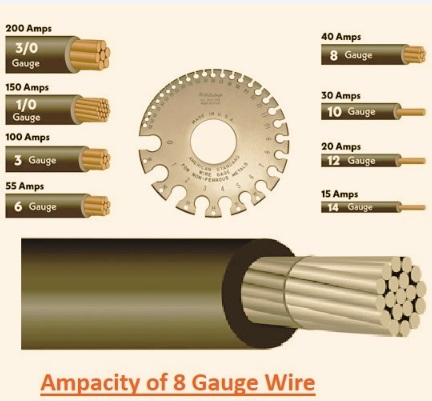
- 8 gauge copper wire has features for handling a 40 to 55 amp rating according to operating conditions.
- Standard wire thickness in North America is the American Wire Gauge (AWG) system. That a small AWG number is defined shows the wire is thick.
- 8 gauge wire has high thickness and is a heavy-duty wire. These wires are identified by size and features for carrying high current.
- These wires are made with copper or aluminum, which are conductive materials, and come with an insulating jacket over them. Insulating jacket materials are PVC, THHN, or XHHW.
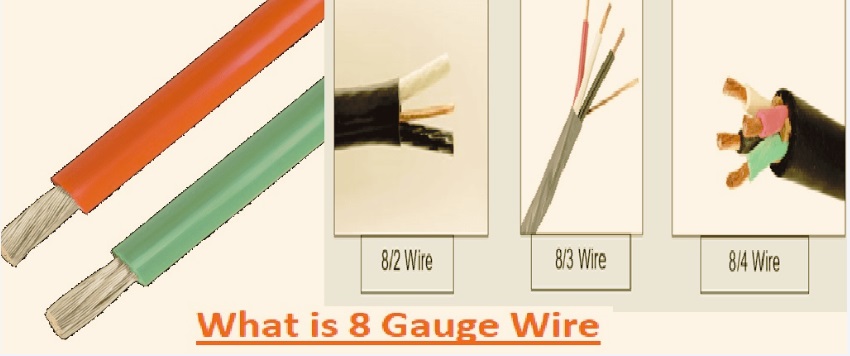
- Based on the number of conductors, 8 AWG wire comes with different configurations like 8/2, 8/3, and 8/4 that are part of different applications
What Is Wire Ampacity?
- Ampacity is a combination of two words: “ampere” or “amp” and “capacity.” Ampacity is the high current that a wire can carry without overheating.
- When current flows in a wire and due to wire’s features. That resistance results in a wire heating up. High current causes high heat.
- If a high current flows for a longer time in a wire, it heats it to a dangerous level. That heat affects wire insulation, causes fires, or, in some conditions, melts the wire.
- So getting an idea of wire ampacity is an important factor for safety hazards. It helps to use wire with the required thickness for handling the connected load.
8 Gauge Wire Ampacity Chart
- Ampacity according to national electrical code are shwon here. These are the highest continuous current loads in standard conditons.
- For 30 degrees ambient temperature, do not use more than 3 current carrying condcutor in cable
| Material | Insulation | Temperature Rating | Ampacity |
|---|---|---|---|
| Copper | THHN, THWN, THWN-2, XHHW | 90°C | 55 Amps |
| Copper | RHW, RHH, USE, XHHW-2 | 90°C | 65 Amps * |
| Copper | TW, UF | 60°C | 40 Amps |
| Aluminum | THHN, THWN, THWN-2, XHHW | 90°C | 40 Amps |
| Aluminum | RHW, RHH, USE, XHHW-2 | 90°C | 50 Amps * |
| Aluminum | TW, UF | 60°C | 30 Amps |
NEC says ampacity should not cross the rating of low-rated components in the circuit. Standard commercial panels and residential circuit breakers and connectors are rated for a temperature of 60°C or 75°C.
For safety purposes, we needed to use an ampacity that fulfilled the ampacity temperature rating.
- For a standard circuit with 75°C terminals, The maximum ampacity for 8 AWG copper is 50 amps.
- For a standard circuit with 60°C terminals, The maximum ampacity for 8 AWG copper is 40 amps.
For general circuits, the standard and safety ampacity value is 55 amps in the case of copper THHN and 40 amps for aluminum.
Factors for 8 Gauge Wire Ampacity
Temperature Rating
- High temperature rating for comparing 90 degrees with 60 degrees helps the wire to carry high current. For 60-degree insulation, the copper rating is 40 amps, and 90-degree insulation uses 55 amps.
Insulation
- Each insulation material comes with a different operating temperature, like 60°C, 75°C, or 90°C. High-temperature insulation, such as THHN, is used for high ampacity compared to low temperature.
Installation techniques
- Wires used in open air dissipate heat properly and carry current safely. wires connected in conduit walls or configured with other wires. Manage heat that reduces ampacity.
Wire Material
- For the same wire dimensions, copper comes with higher ampacity compared to aluminum. Like 8 AWG copper manages 40 to 55 amps, and aluminum manages 30 to 45 amps.
Run length
- Length does not affect ampacity; a longer wire faces high voltage losses. For longer distances, resistance is high, which causes voltage losses when current flows from the supply to operating devices.
Terminal Ratings
- If a wire comes with a high insulation rating, ampacity should follow the low-rated terminal of the circuit. that provide safe operations and follow the national electrical code.
8 Gauge Wire Types
8/2 Wire
- 8/2 wire comes with two insulated conductors that are black and white with a bare ground wire. Its compact design makes it useful for different circuits, and its designs are flat and round. 8/2 wire is part of 240V devices that do not use a neutral wire, like electric water heaters, electric furnaces, and well pumps.
- For the connection and installation of 8/2 wire, follow these points.
- Confirm that devices do not need neutral connections; if needed, use 8/3 wire.
- Label the white wire with black tape if a hot wire is used.
- UF-B cable used for underground connections to avoid weather effects.
- check accurate breaker rating 40-55 amps is used.
8/3 Wire
- 8/3 wire comes with 3 insulated conductors, white, black, and red, with a bare ground wire. An additional conductor enhances the cable’s thickness and capacity for current carrying. It features and is preferred for complicated wiring requirements.
- 8/3 wire used for connection of kitchen ranges and dryer dual-voltage AC units where 240V and 120V are used.
- It is preferred for subpanel circuits used in detached garages, where 240V devices and standard 120V outlets are used
- Follow these points before connecting 8/3 wires and code compliance
- Check that the breaker rating is 40–50 amps.
- Ensure that devices need a neutral connection; otherwise, use 8/2 instead.
- For preventing arcing, maintain strong terminations and strong junctions.
- follow NEC 310.15(B)(16) for ampacity according to temperature ratings.
8/4 Wire
- 8/4 wire comes with 4 insulated conductors, such as black, red, white, and blue, with a bare ground wire. That design is compatible with circuits needed 3 hot wires and one neutral are preferred for commercial 3-phase systems and hot tub setups and subpanels that provide 120V and 240V..
- Its conductor design makes them beneficial where 8/3 or 8/2 wiring is not needed
- Before connecting 8/4 wire with the circuit, follow these pointsto
- ensure either system needed a single-phase or three-phase setup.
- follow rated 3-pole breakers in 3-phase circuits.
- apply accurate rating 3-pole breaker in 3-phase circuits.
- Accurately label conductors to avoid wrong complications during maintenance and installations.
Ampacity of a Wire calculation
Measuring wire ampacity uses wire size, material, insulation, and installation process with temperature rating.
follows these points for measuring wire ampacity
- First find wire materials that is copper or aluminum.
- confirm insulation and temperature ratings like THHN, NM-B, and XHHW-2.
- measure base ampacity given in NEC table of wire gauges, temperature, and material.
- follow the correction process if required.
- ambient temperature more than 30 degrees needing derating. More than 3 current-carrying conductors of conductivity use derating.
- Follow terminal ratings: use a low-temperature rating of wire and terminal
Wiring process of 8 Gauge Wire
Wire Type
- Use proper 8-gauge wire types according to applications like NM-B for indoor applications or UF installed at outdoor and underground installations
- The wire selected must have a feature to manage the required current according to the ampere demand of the system, like 8 AWG wire rating for 40-55 amps.
Installation location
- Before wire installation, accurately set the wire route and location. Check that there is no effect of overheating, damaging chances or moisture exits. If local regulations demand it, then use wire in conduit.
Wire cutting for the required length
- Now calculate the wire length according to the requirements, leaving some extra part at both points for connections. Use wire cutters for heavy gauges, 8 AWG, for effects on wires.
- With the help of strippers, remove certain insulation at ends of the wire; check that there is no damage or scratching of the copper conductors.
- Check that one to two inches of bare copper open for strong connections.
Secure wire connections
- make connection of wire with required terminals, check that each wire is accurately connected. Like black and red wires are live wires connected to the breaker.
- • The white wire is the neutral wire; the bare or green grounding wire is connected with the grounding bus for safe grounding.
- After that, secure the wire over the route through wire clamps and avoid strain on the connecting point. Check that no wire part is causing damage or hazard.
Connections testing
- Before providing power to the circuit, check that connections are properly made and not causing a short circuit. Check that the ampacity of the wire and installation conditions are properly made and follow local electrical codes.
- When installation completed test circuit foraccurate operation. for this purpose use multimeter for checking voltage and ensure that all devices connected with 8 gauge wire operating well
FAQ
8-gauge wires are made with which materials?
- 8-gauge wire generally made with aluminum or copper. Copper is commonly used since it has good conductivity, a flexible design, and durable features. 8-gauge copper is part of residential and commercial wiring since it carries high current with low voltage losses.
- Aluminum has low conductivity compared to copper, is lightweight, and has an effective nature. It’s part of larger projects where costly installations occur. For operating with aluminum wire, special precautions are taken for strong connections and corrosion resistance, like aluminum having more oxidizing features than copper.
Is 8-gauge wire part of outdoor or underground applications?
- 8 gauge wire is part of outdoor or underground applications, but it should have a rating for these conditions. Outdoor-rated 8-gauge wire has a durable design with weather resistance and insulation like thermoplastic, heat- and water-resistant nylon-coated, or underground feeder direct burial.
- For underground installation, it is preferred to bury at a certain depth following local electrical codes: about 18 inches in direct burial or 6 inches with conduit.
How do you properly make a connection of 8-gauge wire in electrical panels?
- Making connections of 8-gauge wire with panels needed proper care and certain tools. First, strip 3/4 inches of insulation at the wire end with a wire stripper so as not to nick the wire strands.
- Put stripped wire into an accurate terminal to make a strong fitting. Tighten terminals for a strong connection and do not over-tighten to save them from damage. If the panel employs screw terminals, check that the wire is wound clockwise over the screw for strong connections.
- Again check connections to ensure they are strongly connected and not causing a short circuit
Are copper-clad aluminum (CCA) wires like pure copper for 8-gauge wires?
- copper-clad aluminum wire created with aluminum and coating to a thin copper layer. That wire is used as a replacement for pure copper wire since it is low cost and low-weight, but it provides high resistance and lower conductivity.
- For high weight and high cost, 8-gauge copper works well for electrical operation.
For 8-gauge wire applications, why does stranded copper replace solid copper?
- stranded copper part of different 8-gauge wire projects since it has a high flexible design compared to solid copper wire. These flexible features make it applicable for vehicles and different industries where wire is installed at certain points without breaking.
What is the use of AWG according to 8-gauge wire?
- AWG numerical system employed for showing size and current for wires. “8-gauge” means wire AWG that has a thick diameter and carries a high current compared to other wires with low gauge ratings. So it is best to use where high power and low resistance are needed.
Why is heat shrink tubing used for 8-gauge copper wires?
- Heat shrink tubing is used with 8-gauge copper wire for protection of the wire connection. When a connection is pulled, heat is given to the tubing for a small design that makes a strong, sealing, and waterproof connection. that avoids short circuits and safe wiring from damage.
Why does bare copper not like tinned copper?
- Bare copper does not have a coating and has a conductive design but is affected by oxidation and corrosion mostly in harsh conditions. While tinned copper comes with a thin film of tin over protective parameters from corrosion and is part of outdoor applications where environment is the main factor,
Is color coding required for the 8-gauge copper wire?
- 8 gauge copper wire comes with color coding for detection when used in the installation process. Red color is employed for positive terminal connections and black for negative terminal connections for battery design. Color coding offers safety connections and easy repairing for electrical systems.
What are the length types of the 8 gauge copper wire?
- For certain features, 8-gauge copper wire comes with certain lenght like 10, 50, or 100 feet. wire used for cables, roofs or phone lines defined with connections or projects