Thermostat wiring is an important factor for managing and controlling HVAC systems at commercial and residential circuits. The most common wire comes in different colors that are important for thermostat wiring purposes. Color codes of thermostat wiring help to find compatibility with different thermostats and the wiring process for operating in different temperatures.
In this tutorial, we will cover detailed features for thermostat wiring and its related factors. So let’s get started.
What is a Thermostat?
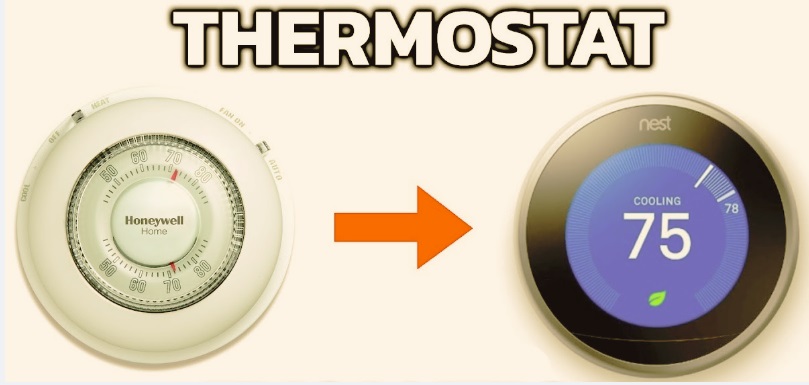
- A thermostat is a control device that uses temperature regulation within a certain range. Its main function is to perform temperature monitoring and make comparisons with the set temperature.
- If the actual temperature value is different from the set value, a signal is delivered from the thermostat to the connected system, like cooling, heating, or ventilation tools, to turn on or off to get the required temperature value.
- The thermostat is part of the HVAC system and also part of other systems such as boilers, furnaces, heat pumps, and water heaters.
- It is usually part of the system where temperature control is needed; a thermostat is used to provide the required value.
What is thermostat wire?
- Thermostat wiring is low-voltage cable, normally used that is in the 18 AWG to 24 AWG range, that manages the signal for the HVAC system. As compared to power cables, thermostat wires do not carry high voltage, but they transmit control signals for the HVAC system and thermostat.
- Wires also come with insulation and are bundled in a core design for performing different operations, like giving power to the thermostat, managing heat, and operating fans.
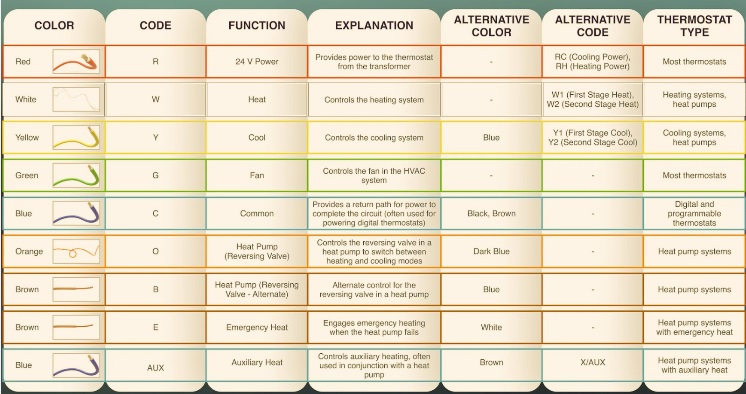
| Wire Color | Wire Label | Function | Applications |
| Red | R / RC / RH | 24V power delivered to the thermostat | HVAC systems (heating, cooling, smart thermostats) |
| White | W / W1 | Controls heating | Furnaces heat pumps |
| White / Brown | W2 | Controls 2-stage heating | Multi-stage heating systems |
| Green | G | HVAC blower fan | Fan-only operation, heating |
| Yellow | Y / Y1 | Controls cooling | Air conditioners, heat pumps |
| Yellow / Light Blue | Y2 | Controls second-stage cooling | Two-stage cooling systems |
| Blue or Black | C (Common) | continuous 24V power to the thermostat | Smart thermostats, advanced HVAC controls |
| Orange | O | Switches the heat pump to cooling mode | Heat pump systems |
| Dark Blue / Brown | B | Switches heat pump to heating mode | Heat pump systems |
| Brown / Light Blue / White | AUX | Provides auxiliary (backup) heating | Heat pumps in cold climates |
| Orange / Brown | E | Controls emergency heat | Heat pump emergency heating |
| Pink / Tan (varies) | L | System status | Advanced HVAC or diagnostic systems |
| Gray (varies) | S1 / S2 | Outdoor temperature sensor | Climate-adaptive HVAC systems |
Thermostat Working
- The thermostat is the main component of controlling the temperature of the home; it detects the temperature of the home and transmits a signal to the HVAC unit for regulation based on the temperature setting and requirements.
- The thermostat is configured with HVAC with different wires. Wire terminals come with markings for connections like heating, cooling, or fan operation.
- It also has distinct terminals that provide power for operating these functions. The thermostat is the main component for handling the HVAC system of our system, and it all occurs with wires. They must connect accurately for heating and cooling maintenance.
How many wires does the thermostat have?
- There are different wires that exist and are used for a thermostat, and there’s no range of 2 to 8. But the commonly used wire configuration is five wires for a thermostat, which is standard for Honeywell thermostats. Some commonly used wire configurations for a thermostat are as
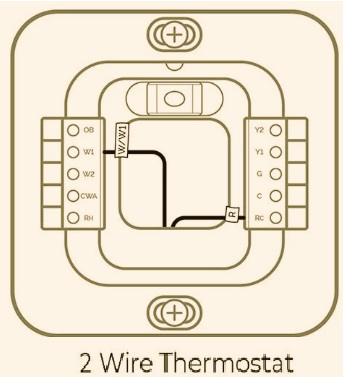
2 Wire
- 2-wire thermostat is part of furnaces and also part of the system where power and heating wires are required
| Wire Color | Wire Label | Function | Thermostat Terminal |
| Red | R (or RH) | deliver power to the thermostat and power to the heating devices | R or RH |
| White | W | Manage the heating system with ON or OFF | W |
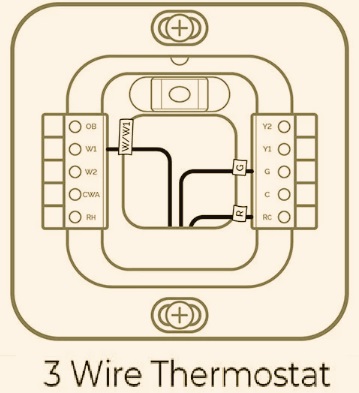
3 Wire
- This wire confuration part of the water heater and boilers, and 3rd wire regulate fan
| Wire Color | Wire Label | Function | Thermostat / HVAC Terminal |
| Red | R (or Rh) | Give 24V power to the thermostat and make communication with the HVAC system | R or Rh |
| White | W | Deliver the signal to the heating system ON or OFF | W |
| Green | G | Regulate the blower fan of the HVAC system | G |
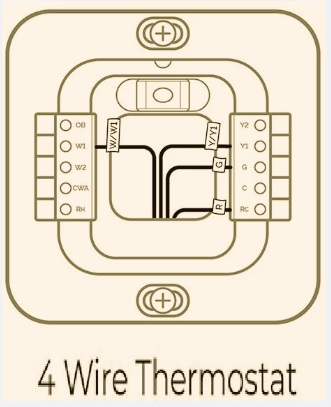
4 Wire
- This thermostat exists in havac sytemand heating pumps. It is a smart thermostat type, and the 4th wire is used for cooling purposes
| Wire Color | Wire Label | Function | Thermostat Terminal |
| Red | R (or RC) | Send 24V power to the thermostat and make a connection with the HVAC system | R or RC |
| White | W (or W1) | Regulate the heating system with a signal to turn ON or OFF | W or W1 |
| Green | G | Manage the HVAC blower fan | G |
| Yellow | Y (or Y1) | manage cooling by providing a signal to the air conditioner or heat pump for cooling or heating | Y or Y1 |
5 Wire Thermostat
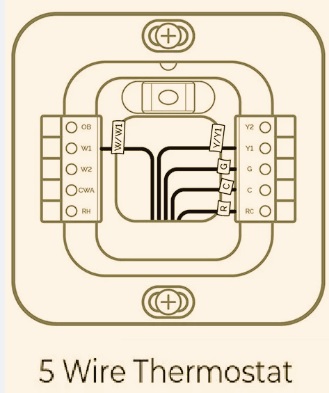
- It is also used in HVAC systems and performs different components assembly, like heat pumps, ac system furnaces. it is part of smart thermostats that use C wires for operation at continous supply
| Wire Color | Wire Label | Function | Thermostat Terminal |
| Red | R | 24V power to the thermostat | R |
| White | W | It provide signal to the conventional heating system to turn ON | W |
| Green | G | HVAC blower fan control | G |
| Yellow | Y | It give signal to the air conditioner to start the cooling | Y |
| Black or Blue | C (Common) | It gives continuous power for smart thermostats | C |
6 Wire
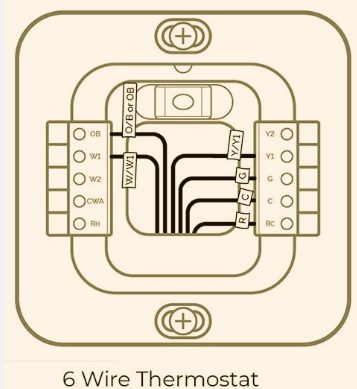
- This wire system is employed for the AC system, and it is a complicated 2-phase heating system with heat pumps having complicated heating and cooling operations using a reverse valve. The reverse valve is the main part of heat pumps that causes switching between cooling and heating modes.
| Wire Color | Wire Label | Function | Thermostat Terminal |
| Red | R | It provides power to the thermostat to control the home temperature | R |
| White | W | Start conventional heating mode | W |
| Green | G | Controls the HVAC fan | G |
| Yellow | Y | Controls cooling / compressor operation | Y |
| Black or Blue | C (Common) | continuous low-voltage power for smart thermostats | C |
| Dark Blue / Brown or Orange | B or O | heat pump between heating and cooling modes | B or O |
7 Wire Thermostat
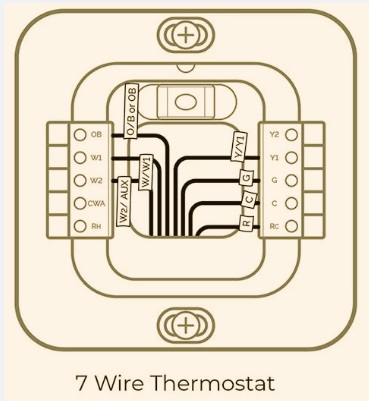
- This thermostat component of ac ssytem, control alarm system, 2 phase heating circuit. in this system 7th wire control 2nd heat phase.
| Wire Color | Wire Label | Function | Thermostat Terminal |
| Red | R | Power to the heating and cooling system | R |
| Green | G | controls the HVAC fan | G |
| White | W | Primary heating | W or W1 |
| Yellow | Y | Controls cooling / compressor operation | Y |
| Black or Blue | C (Common) | continuous 24V power for smart thermostat functions | C |
| Dark Blue or Orange | B or O | heating and cooling modes switching | B (dark blue) or O (orange) |
| White / Brown / Light Blue | AUX (or W2) | Second-stage or auxiliary heating | X/AUX or W2 |
8 Wire
- This thermostat is part of complicated heat pumps that have different heating and cooling phases. its 8 wire compatible with the 2nd cooling phase
| Wire Color | Wire Label | Function | Thermostat Terminal |
| Red | R | power to the heating and cooling system | R |
| Green | G | controls the HVAC fan | G |
| White | W (or W1) | Controls heating | W or W1 |
| Yellow | Y | Controls cooling / compressor | Y |
| Black or Blue | C (Common) | 24V power for smart thermostats | C |
| Yellow or Light Blue | Y2 | Controls 2nd-stage cooling | Y2 |
| White or Brown | W2 | Controls 2nd-stage heating | W2 |
| Orange or Brown | AUX or E | Controls auxiliary or emergency heating | AUX or E |
Thermostat Wiring Color Codes
For proper understanding and connection of the thermostat, its wire color codes are important factors. Wiring connects all components of the HVAC system to make a single configuration.
Each wire is used for performing certain functions; the thermostat comes with four to 16 terminals, according to the device’s working and the HVAC system types used for controlling. Some common color codes for thermostat wiring are as
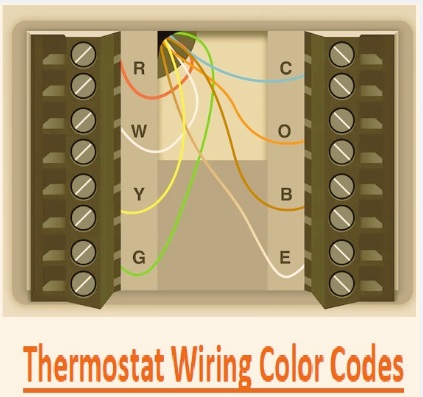
| Color (Terminal) | Working |
| Red (R) | Power |
| Red (RC) | Cooling power |
| Red (RH) | Heating power |
| Yellow (Y Wire) | Cooling |
| Yellow (Y1) | Phase 1 cooling. This wire controll compressor working of the heat pump that performs heating and cooling functions. |
| Yellow (Y2) | Phase 2 cooling |
| White (W) | heating |
| White (W1) | Stage 1 heating |
| White/ Brown (W2) | Stage 2 heating |
| Green (G) | Fan |
| Black/ Blue (C-Wire) | Smart thermostat power source |
| Orange/ Blue | Reverse valve heat pump |
| No universal color (X/Aux) | Auxiliary heat or stage 2 heating |
| No universal color (S) | Outdoor temperature sensors |
Green wire
- The green wire denoted with the letter G is important for controlling the airflow of the HVAC SYSTEM. This wire makes the connection to the G terminal of the thermostat and performs HVAC fan control or blower for hot or cool air circulation.
- setting the “Auto” or “On” option for the thermostat wire on or off the fan
Red color
- The red wire is the power wire and the main wire for the HVAC system, which supplies power to the thermostat with 24V AC power and operates devices.
- Red wire with RH label originating from the heating system. The RC label red wire connected the thermostat with the cooling system.
Y or Y1 wire
- The yellow wire controls cooling functions for the conventional cooling system. A heat pump, it controls the function of the compressor that provides heating and cooling in our homes.
- yellow wire connected with the Yor Y1 thermostat terminal
Yellow / Light Blue wire
- The two-stage cooling system comes with a yellow or light blue wire denoted Y2 that provides cooling power when needed.
- The Y2 wire provides a signal to the 2nd compressor for on/off and extra cooling and heating.
W, W1, AUX, or AUX1
- The W or W1 wire makes a connection of the heating system and signals for starting operation. Just connect with the W or W1 terminal.
- For a boiler or furnace, the white wire is important for making warmth. For having AC or an auxiliary heating pump, the AUX/AUX1 wire is connected with the W1 or AUX terminal on the thermostat.
W2, AUX2, E, E/AUX, E/EM
- w2 wire control 2nd heatingstage that is the high heating stage of the furnace. it used incold weather conditons and when the first stage does not have power for making a proper, comfortable environment.
- if first stage system not providing required heating, 2nd stage is employed. that called auxiliary heat.
- If AUX terminals do not exists than shift the AUX2 wire to the W2 terminal.
- for wires labeling AUX/AUX1/W2 and AUX2, check that first on W1 terminal and AUX2 ofW2 point of thermosate.
- AUX wire having E labeled shows emergency heating
O, B, or O/B Wire
- O/B wire used for heating pump system. This wire comes with an orange color connected to the O/B terminal on the thermostat.
- Not all thermostats provide O/B label clear features, so details are needed from the manual. According to the thermostat, there can be separate O or B terminals connected in a single O/B terminal.
- This wire makes the connection for changes from cooling and heating modes with the reverse valve of the heat pump.
- O/B or O wire manages the cooling mode by transmitting a signal towards the reverse valve. For some heat pumps, the O/B or B wire operates the reversing valve for heating mode.
C-Wire
- A C wire, also known as a common wire, comes in black, blue, or other colors but not red (R), white (W), green (G), yellow (Y), or orange (O/B).
- • The C wire provides a power supply from the HVAC to the thermostat. It operates different features like WiFi connection, LED lights, and programmable settings.
Some Other Thermostat Wires
- Some HVAC systems come with different wires, as mentioned above, that provide different features. such as 3rd-stage cooling or heating, in which accurate wire installation occurs according to the thermostat.
- Some other wires for the thermostat are as
| Label | Working |
| L | It shows an error in old thermostats |
| S, S1 or S2 Wires | temperature sensors |
| G2, G3, GL, GM, or GH | Controls fan speeds |
| Y3 Wire | control stage 3 cooling |
| W3 Wire | stage 3 heating control |
| O & B wires | Perform switching between heating and cooling |
| H/ HUM/ HUM1 and H2/HUM2 | Perform whole-home humidification |
| D/DH/DHUM/DEHUM1 and DH2/DHUM2/DEHUM2 | whole-home dehumidification |
Thermostat Terminals and working
| Terminals | Function |
| R / Rc / Rh | 24V power. R or Rh is for heating Rc for cooling; a jumper make connection of R and Rc . |
| Y / Y1 | Stage 1 cooling |
| Y2 | Stage 2 cooling |
| W / W1 | Stage 1 heating |
| W2 / Aux | Stage 2 heating |
| G | Operate blower for heating/cooling. |
| C | Common wire gives 24V power to smart thermostats. |
| O/B | Reverse valve for heating pumps controls the system to heat or cool. |
| E | Emergency heat |
| L / A | Input of heat pump fault indicators or system alerts. |
| S | Wired indoor or outdoor sensors. |
| U | Humidifier or ventilator control. |
Thermostat Wiring uses
Some common uses of thermostat wiring are as
HVAC Systems
- common use of thermostat wiring for the AC system, heating and ventilation. This feature comes with different wires for managing cooling, fans, heating, and also controlling humidifiers.
Residential Systems
- boilers, furnaces, and radiator floor heating based on thermostats for managing indoor temperature. Some systems come with two to three wires: one used for power, one for heating, and a third for the fan.
Water Heaters
- Temperature regulation occurs for electric and tank-based water heaters, which come with a wire thermostat. Accurate wiring makes water heating accurate without overheating.
Industrial applications
- Thermostat wiring is part of the oven and kilns for managing temperature. It is also used for incubators for stable research. It is also employed for laboratory devices and refrigeration systems.
Refrigeration
- Freezers and walk-in coolers operated with thermostats and wiring operate fans and compressors. It makes regulating temperature easy
Humidity and Air Quality Control
- The thermostats are connected with humidifiers, ventilators, and dehumidifiers. Through wiring, the thermostats control indoor air temperature.
How to Wire a Thermostat
Either thermostat wiring looks complex, but some processes make it easy. Some safety measures ensure each wire is connected accurately to each terminal. Here is a detailed process explained for the thermostat wiring process. Follow these steps.
- First of all, the off switch for removing power from the heating and cooling system through the breaker box. It avoids electric shock and saves components from damage.
- Now, disconnect the old thermostat that can be easily removed, or you can use any tool. Perform disconnection without wire damage.
- Before removing the thermostat, note the wire connection with the old thermostat. That helps to remember the wire connections for the new model
- You can take photos of wiring and label each wire according to the terminal connection (R, W, Y, G, etc.).
- Some thermostats come with a jumper between the R and Rc connections. If the new thermostat comes with R and Rc terminals, there is no need for a jumper. Follow Guildne before connecting the new model.
- Now, connect the new wall plate to the wall. Make its connection straight and strong. A level wall plate helps the thermostat operate properly.
- Connect each label wire with the same terminal of the new thermostat. Check that the wires are connected properly and no bare copper is touching another wire; confirm with the wiring picture.
- On the power supply at the breaker. Set the thermostat to heating, cooling, and fan modes to ensure all functions are working well. If the device is working well means the wiring is accurately done
Conclusion
Thermostat wiring can become difficult, but with proper understanding, we can ensure accurate connections. Follow the terminal label for wiring in, then the wire colors for easy connection. If you have knowledge, you can perform wiring yourself, but it is best to get service from professionals.