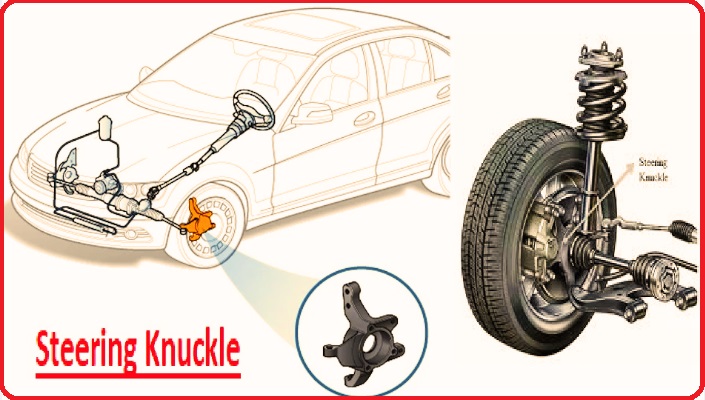
The steering knuckle is the main part of the vehicle that makes the connection between the wheel hub assembly with the suspension and steering. It provides support to vertical wheels and lateral loads and manages wheel pivoting through control arms and tie rod ends. In this post, we will cover detailed features of the steering knuckle and related features to find importance in the vehicle.
What is a Steering Knuckle?
- The steering knuckle, also known as the steering knuckle spindle, is the main part of the steering system that makes the connection between the steering linkage and the front wheel, causing easy directional control of the car
- In automotive suspension, the steering knuckle is typically paired with a spindle or wheel hub and is connected to suspension and steering components.
- A wheel and tire assembly configured with a hub of knuckle where the tire moves through a held-stable motion plane through the knuckle assembly.
- The steering knuckle provides support to bearings and the wheel hub, causing smooth wheel rotation. It also makes the connection of the steering system and suspension deliver forces to the wheels.
- It strongly holds braking parts and mounts brake calipers and rotors.
Steering Knuckle Functions
- Steering knuckles manage the transmission of movement from the steering linkage to the front wheel, helping us to control the car for different directions.
- Its other working to maintain front wheel alignment and maintain position. It maintains tire wear and accurate driving without faults.
Types of steering knuckle
There are two main types of steering knuckles, and each performs certain operations.
Conventional Steering Knuckle
- It is a conventional steering knuckle design that exists in a suspension system where the upper and lower control arms exist. It is also called double wishbone or Short-Long Arm (SLA) suspension.
- It comes with two different pivot points for ball joint assembly, one exists on the upper side and the other on the lower side.
- • The ball joint of the upper control arm makes a connection with the upper side of the knuckle, and the ball joint of the lower control arm is configured to the lower side. This complete design becomes like a box shape.
- shock absorber and spring separated and connected, with chassis and one control arm.
- This design provides control on wheel geometry for parts of heavy-duty trucks and racing cars.
MacPherson Strut Knuckle
- This type of steering knuckle exists on front suspension for different vehicles. Their compact design and low-cost assembly make them effective for MacPherson strut suspension.
- It does not come with a mounting point for the upper control arm but has an integrated bracket.
- The strut assembly body is put into the bracket and connected with one or 2 pinch bolts.
- The steering pivot and upper locating link are struts. The knuckle also comes with a mounting point at the lower side of the lower control arm’s ball joint.
- But overall assembly of this structure is less complex and lightweight compared to the double wishbone setup.

Identification of Steering Knuckles types
When we check the car wheel, we will come to know about the knuckle type through getting an idea of the related connected components. If you found a tube-shaped strut connected at the side of the knuckle, that means it is a MacPherson strut system. I
Follow these points also for the detection of the steering knuckle.
- The common indication of a MacPherson strut knuckle is the existence of a strut. If the tube-shaped design has a spring that is connected with a bracket on the steering knuckle side. It also has a lower control arm at the bottom design.
- In this step, check two control arms, then find that the lower control arm is connected with the lower knuckle through a ball joint. After that, check the axle and brake disc, then find the upper control arm connected with the knuckle above the side, so we have a conventional knuckle in the double wishbone suspension.
Steering Knuckle Parts
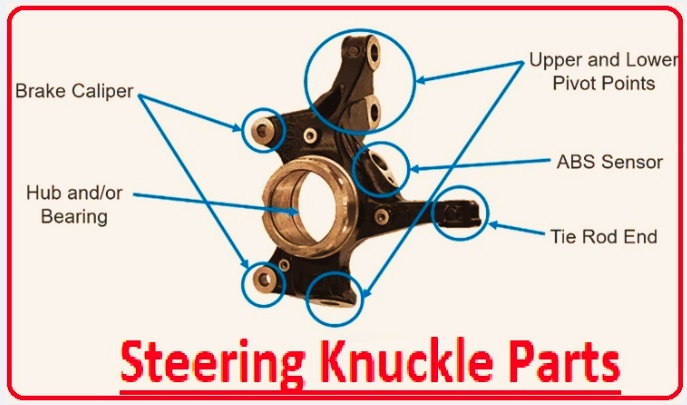
The working of steering knuckles occurs through different parts, and each performs certain operations.
Hub Mounting Point
- At this point the wheel hub and bearing are connected.
Steering Arm
- This part is connected with the tie rod for controlling the direction of the wheel.
Ball joint points
- These connections are connected with the control arm for providing up and down motion.
Suspension Mounting Points
- Through this point, it connected with the control arms or struts.
Brake Caliper Mounting Bracket
- This makes a strong connection between the brake caliper and the rotor.
How Steering Knuckles Change Vehicle Direction
- The upper and lower arms of the steering knuckle are connected with the suspension system through pivots or ball joints. Ball joints cause knuckle pivots in different directions.
- It keeps the knuckle at 90 degrees, and the steering knuckle comes with a lateral arm connected with a tie rod.
- When we steer the tie rod, apply force on the lateral arm outward or inward according to the turning direction of the steering wheel.
- Vehicles have tie rods on both sides; if the lateral arm of one side pushes outward, the other lateral arm is pulled inwards. In this way knuckles and front wheels move uniformly.
Effects of Damaged Steering Knuckle
- Normally, steering knuckles come with a strong structure, so they work longer, but if a knuckle gets damaged due to an accident or a big pothole. Breaking of knuckles affects vehicle movement.
- Either damage to the steering knuckle —we should drive, but it is not recommended. If you drive with a broken steering knuckle, you will face some faults like
- Wheel alignment will be affected, which causes tire wear and improper handling.
- Damaged knuckles also apply high pressure on ball joints, since they can be damaged.
- If the ball joint is not working or is damaged, steering becomes difficult, and we lose vehicle control. So, repair the damaged steering knuckle if you find it as soon as possible.
Sign of Damaged Steering Knuckle
Some signs indicate the steering knuckle is damaged and needs replacement or repair.
- if the front wheel is showing a larger tilt than the 2nd.
- noise produced during vehicle turning
- During straight driving, it causes crooked steering, and the vehicle badly corners during single-direction steering.
Replacing the process car’s steering knuckle
Follow these steps for steering knuckle replacement.
- First, lift the vehicle with the use of a hydraulic jack and set it on a jack stand.
- Disconnect the front wheel where the steering knuckle needs to be replaced.
- Now separate the steering knuckle by loosening the steering knuckle nuts and disconnecting from the steering ball joint using a mechanical tool.
- After disconnecting the older steering knuckle, connect the new module, connect the front wheel, and tighten the nuts of the wheel.
- Now take a test of the new connected steering knuckle.
How much costfor Replacing a Car’s Steering Knuckle?
The replacement cost of a steering knuckle is defined according to vehicle type, country location, and repairing center costs. Normally the replacement cost of a steering knuckle is $400 to $900.
but can vary according to different requirements
Conclusion
Steering knuckles are important for the suspension and vehicle steering system, which manage the handling, safe working, and smooth driving.
FAQs
What is the function of the steering knuckle?
- Steering knuckles provide directional control according to steering wheel inputs. The steering knuckle component of the wheel hub that connects with the wheels. Movement of the steering knuckle provides vehicle directional variation.
Does the steering knuckle affect alignment?
- Pothole or curb hitting affects chassis parts to move and move according to the impact. Minor warping of the knuckle affecting vehicle alignment causes damage to different suspension parts.
What are the symptoms of a bad steering knuckle?
- There are different signs of a faulty steering knuckle, such as a grinding or clunking sound being produced or steering wheel vibrations. Also, the vehicle pulling to one side and tire wear are signs of a faulty steering knuckle.
How do I know if I need a steering knuckle?
These symptoms are signs of a faulty steering knuckle.
- wheel vibrations
- steering shift to one side.
- tire wear and faulty steering wheel alignment
What is the most common cause of heavy steering?
- Steering fluid is low power.
- leaking steering pump
- damaged serpentine belt
- high thickness of steering fluid
- low tire pressure and suspension problems.
- bad steering rack with damaged shaft joints
Do I need an alignment after replacing a steering knuckle?
- Alignment is an important factor for replacing the steering knuckle. that also makes accurate wheel alignment that controls tire wear and provides easy handling. Alignment settings provide safe operations and maintain the operations of suspension parts and also steering knuckle.
What’s another name for steering knuckle?
- A steering knuckle is also called a wheel knuckle or a suspension knuckle.