The battery has now become the main component of our daily lives since almost every power-consuming device, such as phones and vehicles, works on battery power. Batteries come in different types, and each has its own features and uses. In this post, we will cover detailed features of a 36V battery and its subtypes. So let’s get started.
What Is a 36V Lithium Battery?
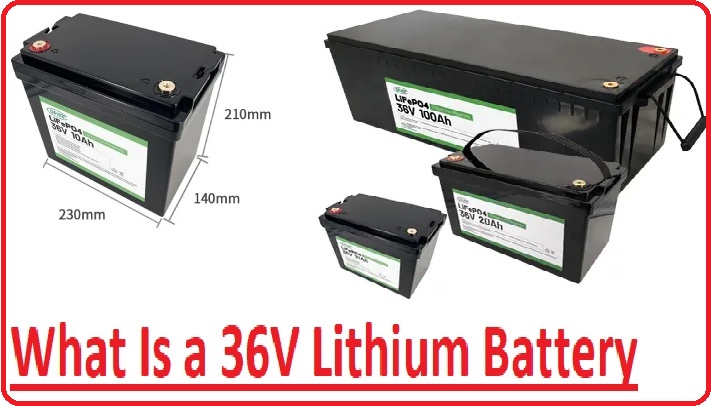
Lithium-ion or lithium iron phosphate cells in series combinations give 36V and make a 36V lithium battery that also offers recharging features.
If a 3.6V cell is used, 10 cells are needed in series for a 36V battery. Its small size makes this battery the best option due to its small size and high density compared to lead-acid batteries.
This battery offers steady voltage for a longer time, which helps devices to work well. A 36V battery is preferred for mid-level options.
36V Lithium Battery Working
Lithium ions exist between positive and negative electrodes during charging and discharging in a 36V lithium battery.
Lithium ions move from the positive cathode to the negative anode in the electrolyte during the charging process.
While in the discharging process, ions move in the reverse direction and energy is released.
These ions’ movement is affected by current, temperature, and voltage parameters.
36V lithium battery Construction
Cells
Cells of a battery are important components for making a battery high capacity instead of using larger-sized cells. That’s helpful for high current sharing and reduces single-cell pressure.
Battery Management System
BMS controls overcharging, overdischarging, temperature, and current variations and their effects. A battery management system is an important factor for 36-volt lithium marine batteries since they work in moisture and vibration conditions.
Design
The design of the battery is important since accurate spacing, insulation, and casing of the design affect working life.
BMS practical effects on a 36V battery
Protection response time
A fully charged 36V pack causes more than 200 amps at the time of short-circuit conditions. If the BMS is working well, it responds very fast, in about 50-100 microseconds.
Overcharge protection
BMS stops at 4.2V per cell; low-cost boards use a single voltage reference for the complete pack compared to controlling a single cell.
Ten cells for 42V are working well when a single cell is 4.5V, and the other is 3.9V… high cells are affected with each charge cycle. With 200 cycles, it degraded.
Over-discharge protection
BMS cuts output at 3V for one cell. Low-cost boards monitor total pack voltage and do not follow single cells that lose a very low value, but others are higher.
One cell is affected by deep discharging, and it takes time for net capacity to be monitored
Types of 36V Batteries
There are different types of 36V batteries; each has its own features and services.
36V Lithium-Ion (Li-ion) Batteries
It is lightweight and also high-energy-density, with high power. Its chemical composition uses lithium salts in organic solvents, and lithium ions move between anodes and cathodes to produce power.
• The main features of this battery are high energy density, high-speed charging, longer life, and needing less maintenance.
But it has high costs and is affected by high and very low temperatures.
36V Nickel Metal Hydride Batteries
Its main features are moderate energy density with high weight compared to lithium-ion batteries. Its chemical composition comes with nickel oxide hydroxide and a hydrogen-absorbing alloy.
It is low cost and works well but has a short working life, slow charging speed and a memory effect if not fully discharged
36V Sealed Lead Acid (SLA) Batteries
- It is heavy with low density, and the chemical composition is lead dioxide and sulfuric acid. But it’s low cost and reliable. It is heavy, with a short life
36V Lithium Battery vs Lead-Acid
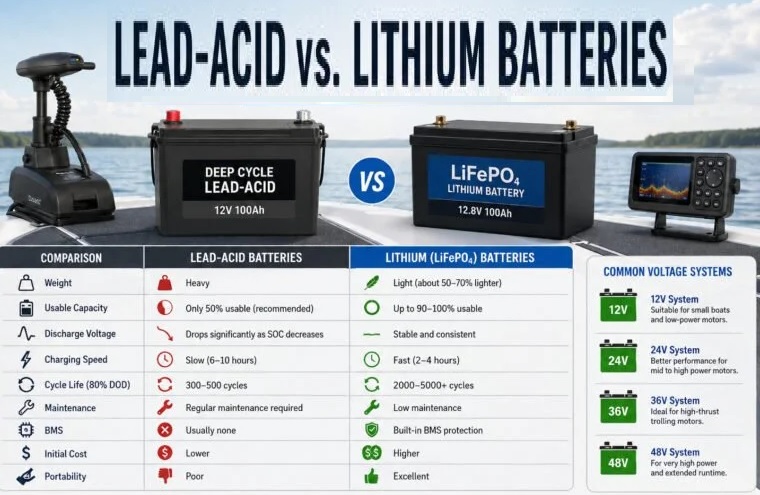
| Technical Feature | 36V Lithium Battery | 36V Lead-Acid |
| Nominal Voltage | 36V | 36V |
| Common Chemistry | Li-ion / LiFePO4 | Flooded / AGM / Gel |
| Cell Nominal Voltage | 3.2–3.7V | 2V |
| Typical Series Cells | 10S Li-ion / 12S LiFePO4 | 18 cells |
| Full-Charge Voltage | 42.0V Li-ion / ~43.8V LiFePO4 | ~43.2–44.4V |
| Energy Density | High | Low |
| Typical Energy Density | ~90–250 Wh/kg | ~30–50 Wh/kg |
| Usable DoD | ~80–100% | ~50% commonly used |
| Cycle Life | ~1,000–5,000+ | ~200–1,000 |
| Round-Trip Efficiency | ~90–98% | ~70–85% |
| Voltage Sag | Low | Higher |
| Self-Discharge | Low | Moderate |
| Weight | Lower | Higher |
| Charging Efficiency | High | Lower |
| Fast Charging | Generally supported | limited |
| BMS | Required | not required |
| Maintenance | Very low | Flooded types require maintenance |
| Thermal Management | Important | during charging |
| Low-Temperature Charging | Protection required | tolerant, depending on type |
| Memory Effect | None significant | N/A |
| Energy-to-Weight Ratio | High | Low |
36V Lithium-Ion vs Lead-Acid Battery
Read also CR2330 Battery, Features, Working, Uses, & Equivalent
| Technical Feature | 36V Lithium-Ion | Lead-Acid |
| Chemistry | NMC/NCA Li-ion | Lead-acid |
| Nominal Voltage | ~36–37V | 36V |
| Cell Voltage | 3.6–3.7V | 2V |
| Series Configuration | 10S | 18 cells |
| Full Charge Voltage | 42.0V | ~43.2–44.4V |
| Energy Density | ~150–250 Wh/kg | ~30–50 Wh/kg |
| DoD | ~80–90% | ~50% |
| Cycle Life | ~1,000–3,000+ | ~200–1,000 |
| Efficiency | ~90–95% | ~70–85% |
| Internal Resistance | Low | Higher |
| Voltage Stability | High | Moderate |
| BMS | Required | not required |
36V LiFePO4 vs Lithium-Ion
| Technical Feature | 36V LiFePO4 | 36V NMC Li-Ion |
| Chemistry | LiFePO4 | NMC |
| Cell Voltage | ~3.2V | ~3.6–3.7V |
| Series Configuration | 12S | 10S |
| Nominal Pack Voltage | ~38.4V | ~36–37V |
| Full Charge Voltage | ~43.8V | 42.0V |
| Energy Density | ~90–160 Wh/kg | ~150–250 Wh/kg |
| Cycle Life | ~2,000–5,000+ | ~1,000–3,000+ |
| DoD | ~80–100% | ~80–90% |
| Thermal Stability | Excellent | Good |
| Round-Trip Efficiency | ~90–98% | ~90–95% |
| Weight | Higher | Lower |
| BMS | Required | Required |
36V Lithium Battery vs 48V Lithium Battery
| Technical Feature | 36V Lithium | 48V Lithium |
| Nominal Voltage | 36V | 48V |
| NMC Configuration | 10S | 13S |
| NMC Full Charge | 42.0V | 54.6V |
| LiFePO4 Configuration | 12S | 16S |
| LiFePO4 Nominal Voltage | ~38.4V | ~51.2V |
| LiFePO4 Full Charge | ~43.8V | ~58.4V |
| Energy at 10Ah | ~360Wh | ~480Wh |
| Energy at 20Ah | ~720Wh | ~960Wh |
| Current at 1,000W | ~27.8A | ~20.8A |
| Cable Loss at Same Power | Higher | Lower |
| Voltage Drop at Same Power | Higher | Lower |
| Controller Voltage | 36V | 48V |
36V vs 24V Lithium Battery
| Technical Feature | 36V Lithium | 24V Lithium |
| Nominal Voltage | 36V | 24V |
| Typical NMC Configuration | 10S | 7S |
| NMC Full Charge | 42.0V | 29.4V |
| Typical LiFePO4 Configuration | 12S | 8S |
| LiFePO4 Nominal Voltage | ~38.4V | ~25.6V |
| LiFePO4 Full Charge | ~43.8V | ~29.2V |
| Energy at 10Ah | 360Wh | 240Wh |
| Energy at 20Ah | 720Wh | 480Wh |
| Current at 500W | ~13.9A | ~20.8A |
| Current at 1,000W | ~27.8A | ~41.7A |
| Voltage Drop at Same Power | Lower | Higher |
| Cable Loss at Same Power | Lower | Higher |
Lithium Battery vs AGM Battery
| Technical Feature | Lithium Battery | AGM Battery |
| Chemistry | Li-ion / LiFePO4 | Lead-acid |
| Cell Voltage | ~3.2–3.7V | ~2V |
| Energy Density | ~90–250 Wh/kg | ~30–50 Wh/kg |
| Usable DoD | ~80–100% | ~50% |
| Cycle Life | ~1,000–5,000+ | ~200–1,000 |
| Efficiency | ~90–98% | ~70–85% |
| Voltage Sag | Low | Higher |
| Charging Efficiency | High | Lower |
| Charging Rate | Higher | Lower |
| Weight | Lower | Higher |
| Self-Discharge | Low | Low–moderate |
| BMS | Required | Normally not required |
| Electrolyte | Lithium electrolyte | Sulfuric acid absorbed in glass mat |
Factors for Voltage of 36V Lithium-Ion Battery
There are different factors that affect 36v lithium-ion voltage and its working.
State of Charge
Battery voltage is based on state of charge. High voltage means a high charge level, and low voltage equals a low charge level.
Temperature
High and very low temperatures affect voltage, such that high temperature reduces the maximum voltage threshold.
Low temperature increases internal resistance and reduces effective voltage.
Load
Voltage losses occur during high loads since internal resistance occurs. That process is called voltage sag, temporarily during low load conditions.
How to Charge a 36V Lithium-Ion Battery
A proper charging process is important for maintaining voltage limits that make a 36V lithium battery work accurately. For proper charging of a 36V lithium battery, follow these points.
Charger compatibility
Use a charger that is designed for 36V lithium-ion batteries. Such a charger has features for charging a battery at about 42V without affecting the safe voltage value.
Overcharging prevention
If the battery is overcharged, it becomes overheated and affects its working life. Some chargers come with an overcharging protection system.
Working Temperatures
Operating temperature also affects battery charging, such that if we charge the battery at very low or very high temperatures, it affects efficiency and voltage limits.
The ideal temperature range for battery charging is 10°C to 30°C.
Voltage maintenance of a 36V lithium-ion battery
For accurate working conditions of 36 lithium batteries, follow these points.
Voltage monitoring
A voltmeter is the best option for checking battery voltage, which is helpful for the detection of faults in early stages.
Prevent Deep Discharges
Battery capacity is lost if discharging reduces to 30V. So recharge the battery before it reaches the recharging limit.
Partial charge storage
If the battery is stored for a longer time, set the charging level up to 60 percent; that reduces stress on cells.
36V Lithium-Ion Battery Application
There are different uses of a 36V battery; some are
Electric Bikes
Electric bike motor power comes from a 36V battery; voltage in limited ranges manages abrupt power losses.
Power devices
Cordless power devices operate with 36V lithium-ion batteries. Proper voltage values enhance runtime and control overheating when high power is needed.
Renewable Energy Storage
The solar system also employs a lithium-ion battery. Since voltage regulations prevent overcharging when power varies
How to troubleshoot Voltage faults in a 36V Lithium-Ion Battery
Different voltage-related problems occur that affect the battery. Follow these points for solving faults.
Overcharging
If battery voltage crosses 42 volts, do not charge the battery; monitor the charger working well and monitor BMS working well.
Low voltage value
If the battery voltage is below 30 volts, do not use the battery further; recharge it with a supported charger.
Test cell degradation
Voltage variations
If voltage changes under high load, there can be loose connections; check for battery damage signs, and if needed, replace battery terminals when high internal resistance exists.
36V Lithium Battery Aging Sign
Range reduction
It is a common sign of battery aging if the battery works for 50 km in your scooter but reduces to 25 km, meaning capacity is reducing.
Power losses
High internal resistance means battery aging; during acceleration, the battery not providing enough current means voltage losses. For some conditions, the device can tell if some charging exists.
abnormal charging
If battery charging time is instantly reduced, that is an alarming condition. That means battery energy storage capacity is highly reduced.
Overheating
For normal conditions, the battery is cool; when using it, it becomes hot. That means internal resistance increases and causes heat.
Physical Deformation
The battery’s physical shape varies; that is an important fact. That is the reason for gas building in the structure. When this condition occurs, do not use the battery further since it causes fire.
Self-Discharging
- An accurate working battery stores charge for a longer time when not used. if losing high power rapidly, it means the battery’s working life is affected
Advantages of a 36V lithium battery
There are main advantages of a 36V lithium battery, and some are the following:
It has high power storage compared to normal cells. so used in mobile phones
Its high output power and high charging capacity handle high temperatures.
It is rechargeable and can be recharged many times
This battery is helpful for the drone when it’s airborne and off.
FAQs
What is the charging process of the 36V lithium battery pack?
A 36V battery charging station is the best option for charging phones shortly. A 3.6-ampere output is used for charging two phones and also provides power to a PC for a limited time.
What are the quality standards of a 36V lithium battery?
UL 1642 standard is used for lithium batteries. That standard applied for battery testing. Since lithium batteries are a common part of electric vehicles and also portable devices…
What is discharging a 36V lithium battery?
If you are storing a battery for a longer time, check that the battery is half charged.
What happens if a lithium battery is not used for a long time?
Self-Discharge:
A lithium battery loses charge in one month if not used for a longer time.
Deep Discharge:
If not used for a long time, voltage losses are to be at a safe minimum level. When it occurs, internal safety functions stop, and battery recharging becomes difficult.
How to maintain the 36V lithium battery?
If the 36V lithium battery is fully charged, keep the room temperature in the range of 20 to 50 degrees Celsius. For a longer life of a battery, maintain it at room temperature. not do full discharging of the battery, but partial releases for a longer battery life
A 36v lithium battery has features for working in different temperature values. since other batteries do not work at extreme temperatures.
This battery has high energy density, so it does not need a charging circuit that applies to battery longer life.
Is a 36V Lithium Battery Better Than Lead-Acid?
In terms of capacity, a lithium battery is 1/3 the weight of a lead-acid battery with the same capacity, which helps to ease installation.
Lead-acid batteries lose voltage during discharging, which affects their performance. But lithium batteries maintain voltage during the discharging cycle. It also supports deep discharging and lead-acid battery damage if discharging higher than 50 percent.
A lithium battery has a high cost that normally lasts five to ten years and a higher life cycle than lead-acid batteries.
How long does a 36V lithium battery last?
A properly working 36V lithium battery can last for up to seven years or 2,000–3,000 full charge cycles
Conclusion
A 36V lithium battery comes with high efficiency and safe operation, with a durable design for different applications like electric bikes, industries, and solar design, with a BMS system. Battery packs with quality cells are highly efficient.