20 AWG wire is commonly used for electronic wiring systems such as sensors and low-power audio signals due to its good handling, good bending features, and low cost as a wiring option. In this tutorial, we will cover details about 20 AWG wire and related factors. So let’s get started
Introduction to 20 AWG Wire
20 AWG wire shows conductor size according to the American Wire Gauge (AWG) system. AWG is basically a wire sizing standard that is used in the USA and in the international cable industry.
It helps to find conductor diameter with a numerical scale that helps us compare wire sizes.
If the wire has a smaller AWG, it means a larger conductor.
A larger AWG means a smaller conductor.
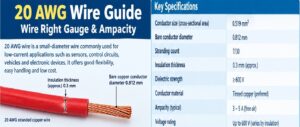
20 AWG wire is a small-diameter wire having a conductor cross-sectional area of 0.519 mm², and the bare copper conductor diameter is 0.812 mm.
This wire is used for low-current projects, such as sensors, vehicles, control wiring, and DC components.
What is the Ampacity of 20 AWG Wire?
20 AWG wire comes with a wire ampacity rating of 3.5 amperes for safe functioning, which handles about 11 amps of current in free air and 5 amps in ideal conditions. Normally, the rating is 3-5 amps.
Current capacity can be different according to wire length, since resistance is 92 feet for a single ohm at 77farhenheight.
In a long run cable, high voltage occurs, which minimizes effective current.
20 AWG wire features
Ampacity:
• The ampacity of 20 AWG wire is 3.5 amperes for free air and 2.5 amperes in conduit conditions.
Conductor material:
The different material used for 20 AWG wire is tinned copper that has good resistance compared to bare copper. That works well for humid conditions. Aluminum is not used since it has high resistance
Insulation thickness and dielectric strength:
- It comes with 0.3mm wall thickness for high mechanical strength, and the dielectric rating is ≥600 V, confirming a safety factor for 24 V systems.
Stranding count:
- it has7/30 that provides good flexibility and crimp reliabity. that prevneting ultra fines stranding
20AWG Wire Amp Rating
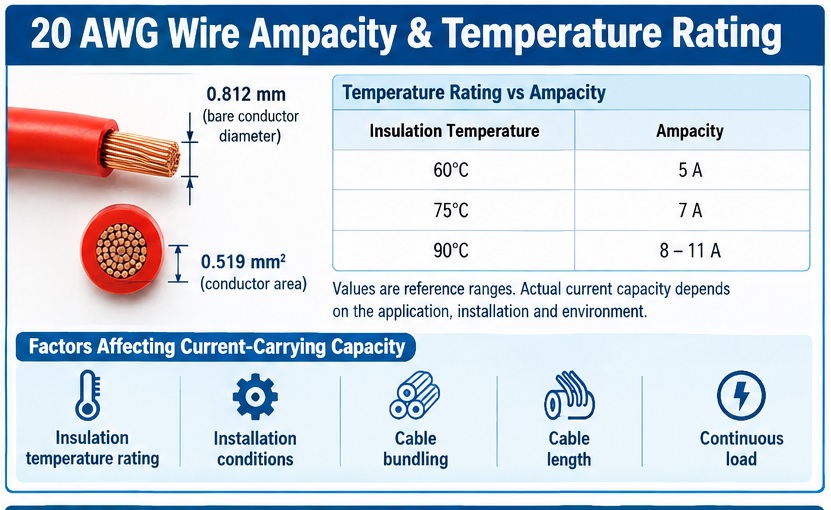
An important point about 20 AWG wire is to know the current-carrying capacity of a 20-amp wire. It is not a fixed value for current carrying to the wire. Different factors such as insulation temperature rating, insulation technique, ambient temperature, and length of cable affect working current.
For these factors, ampacity is a reference factor.
Accuracy: 20 AWG cable needs to follow voltage and current capacity.
A rating of 20 AWG copper wire is based on temperature
| Temperature Rating | Ampacity |
| 60°C | 5A |
| 75°C | 7A |
| 90°C | 8–11A |
These are value references, but the real value depends on use.
Factors affecting the current-carrying capacity of 20 AWG wire are
Insulation
High-temperature insulation causes high-function limitations.
Installation conditions
Improper heat dissipation results in reduced current capacity.
Cable bundling
Different cables in bundles cause heat generation.
Cable length
Long cables cause voltage losses
Continuous load
If a wire is working continuously under load, it causes high stress.
Selection factor for 20awg wire
These are factors that are checked before selecting 20awg wire
| Technical Factor | Specification |
| Maximum current | 3.6 A for 60 WS2812B LEDs at 60 mA each |
| Recommended wire gauge | 18 AWG for current draws ≥ 3 A, based on ampacity and voltage-drop checks |
| Wire flexibility | Stranded for flexible applications; solid for permanently fixed wiring |
| Ambient temperature | more than 60°C: focus for silicone insulation |
| Crimp termination | Stranded wire |
| Screw terminals | Solid wire can be suitable |
| CCA resistivity | 1.6× higher than copper |
| Breadboard-to-PCB jumpers | Prevents solid-core wire where vibration may cause breakage |
| Voltage drop | 0.15 V at 2 A over 2.5 m, as provided |
Types of 20 AWG wire
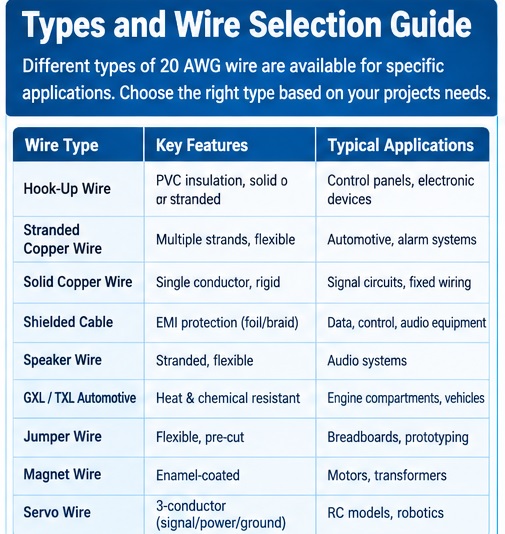
| Wire Type | Technical Features | Voltage / Temperature Rating | Applications |
| Hook-Up Wire | PVC insulation; comes in solid or stranded copper | UL 1007: 300 V; UL 1015: 600 V | Control panels, electronic devices |
| TFFN Wire | Thermoplastic insulation with nylon coating; flexible design | Up to 600 V | Lighting fixtures, small appliances |
| Stranded Copper Wire | Multiple copper strands; high flexibility | Based on insulation type | Automotive wiring, alarm systems, electronics |
| Solid Copper Wire | Single solid copper conductor; rigid construction | According to insulation type | Signal circuits, fixed wiring, control circuits |
| Shielded Cable | Foil or braided shield to reduce electromagnetic interference (EMI) | Depends on cable construction | Data communications, , control systems, audio equipment |
| Speaker Wire | stranded copper with flexible insulation | insulation type | Speaker connections, audio systems |
| Thermostat Wire | multiple insulated conductors with PVC insulation | cable specification | HVAC controls, thermostats |
| Alarm and Security Cable | Solid or stranded conductors; often multi-conductor construction | Depends on cable specification | Security sensors, cameras, alarm panels |
| GXL Automotive Wire | Thin-wall cross-linked polyethylene (XLPE) insulation; resistant to oil, chemicals, and abrasion | Up to 125°C | Engine compartments, automotive circuits |
| TXL Automotive Wire | Extra-thin-wall insulation; suitable for compact installations | Up to 150°C | Vehicle wiring in tight spaces and high-temperature areas |
| Bell Wire | Solid copper with PVC insulation | Depends on wire specification | Doorbells, low-voltage signaling, simple alarm circuits |
| Brass Wire | Brass alloy conductor; lower electrical conductivity than copper | Depends on design | Specialty connections, crafts, mechanical models |
| Jumper Wire | Flexible stranded construction; often pre-cut and stripped | Insulation and conductor specifications | Breadboards, PCB prototyping, electronic assemblies |
| Magnet Wire | Enamel-coated copper conductor; thin insulation supports compact coil winding | Enamel insulation class | Motors, transformers, solenoids, electromagnets |
| Servo Wire | Flexible stranded conductors; often a 3-conductor cable for signal, power, and ground | cable specification | RC models, robotics, servo motor connection |
20 AWG vs 14 AWG and 12 AWG Wire
| Technical parameter | 20 AWG | 14 AWG | 12 AWG |
| AWG size | 20 | 14 | $12.00 |
| Bare conductor diameter | 0.812 mm | 1.628 mm | 2.053 mm |
| Cross-sectional area | 0.518 mm² | 2.08 mm² | 3.31 mm² |
| Copper resistance at 20°C | 33.31 Ω/km | 8.286 Ω/km | 5.211 Ω/km |
| Copper resistance per 100 ft | 1.015 Ω | 0.2526 Ω | 0.1588 Ω |
| Copper weight per km (approx.) | 4.64 kg | 18.6 kg | 29.6 kg |
| Relative conductor size | Small | Medium | Large |
| Relative voltage drop at equal current and length | Highest | Lower | Lowest |
| Typical insulation options | PVC, XLPE, PTFE | PVC, THHN/THWN-2, XLPE | PVC, THHN/THWN-2, XLPE |
| Typical applications | Sensors, signal circuits, control wiring | Lighting and 15 A branch circuits | 20 A branch circuits and higher-load wiring |
| Flexibility | High | Moderate | Lower |
| Typical US residential breaker pairing | used for standard branch circuits | 15 A | 20 A |
| Primary advantage | Compact and lightweight | Balance of size and current capacity | Lower resistance and voltage drop |
Electrical Performance Comparison
| Parameter | 20 AWG Copper | 14 AWG Copper | 12 AWG Copper |
| Resistance per 1000 ft at 20°C | 10.15 Ω | 2.526 Ω | 1.588 Ω |
| Voltage drop at 5 A over 100 ft one-way* | 10.15 V | 2.53 V | 1.59 V |
| Voltage drop at 10 A over 100 ft one-way* | 20.30 V | 5.05 V | 3.18 V |
| Relative resistance compared with 12 AWG | 6.39× | 1.59× | 1× |
| Relative copper cross-sectional area | 1× | 4.02× | 6.39× |
Avoid these things when choosing 20 AWG
Selecting 20 AWG wire is easy, but it needs precautions during selection that must be considered.
An environment where wire usage is important for practical functioning. Such 20 AWG cable connected for short indoor circuits works well, but if that same wire is used for outdoor cables, it faces high voltage losses
There is some error that must be considered when using 20 AWG wire.
if we think the AWG number is the same as the amp rating
A common error is considering the AWG number denoting the current capacity of the wire, such as
One of the most common misunderstandings is assuming that the AWG number directly represents the
20 AWG is not equal to 20 amps.
18 AWG does not equal 18 amps.
12 AWG is not equal to 12 amps.
The AWG number does not define the conductor size but the current capacity based on
Conductivity material is an important factor since aluminum and copper have different resistances.
Insulation temperature rating is best to define the highest operating temperature.
Installation techniques affect heat dissipation and cable length voltage drop
Voltage Drop
Voltage loss is a common error for changing small wire sizes that normally occurs in low-voltage applications
Solar systems
LED lighting
control equipment.
Battery operating devices;
Since 20 AWG has a small conductor area, it has higher resistance than larger cables, e.g., 18 AWG or 16 AWG.
When current moves in longer cables, resistance results in voltage loss.
A small 20 AWG with small loads works well, and another cable employed for longer lengths with 12, causing a functioning error and improper voltage for the load because it functions erratically and has an improper effect on device functioning
In this condition, it does not reduce current, so use a larger conductor
Frequently Asked Questions
What is the 20 AWG wire size?
20 AWG comes with a 0.519 mm² cross-sectional area, and the bare copper conductor diameter is 0.812 mm. In metric cable features, 20 AWG is covered with 0.5 mm² wire if either of the two features are different. Conductor material, insulation, and cable design provide cable working
although the two specifications are not identical.
What are 20 AWG wire uses?
20 AWG wire is normally part of applications where low current is needed and compact size is an important factor. such as control circuits;, sensors;automotive electronics; monitoring systems;battery management connections, and small DC devices.
20 AWG is typically used for communication, wiring, and monitoring. In high-current projects like inverter connections, battery cable
Is 20 AWG thicker than 18 AWG?
No. 20 AWG wire has less thickness compared to 18 AWG
| Wire Size | Conductor Area |
| 18 AWG | 0.823 mm² |
| 20 AWG | 0.519 mm² |
Can 20 AWG wire work on 3 amps?
20AWG wire has features for managing a 3-amp load in normal working conditions. Some factors show working features on cable length, voltage, installation conditions, and voltage losses
For low-voltage connections, 20 AWG works well, and longer cable connections are used for voltage losses and maintain stable working conditions
Does 20-gauge wire have high strength?
20 AWG is used for low-current projects compared to high-power transmission. It is weaker than wires such as 16 AWG. But 20 AWG comes with a flexible design and easy connection
In high-vibration projects,, standard 20 AWG copper wire is used due to flexibility and durability.
Which wire, 18 or 20 gauge wire, is high strength?
18 AWG wire has higher strength compared to 20 AWG for electrical capacity and conductor size.
18 AWG wire is used for high current, longer cables, and lower voltage losses
20 AWG is employed for flexible design; circuits needing low current in space are limited
Is 20 AWG wire used for solar panels?
Yes, used in the solar system with devices that need low current, such as monitoring devices, control connections, and sensors
But not used for PV string wiring, inverter connections, battery cables, panels output cables
What is the difference between 20 AWG and 0.5 mm² wire?
| Technical parameter | 20 AWG wire | 0.5 mm² wire |
| Wire size standard | American Wire Gauge (AWG) | Metric cross-sectional area |
| Conductor area | 0.518 mm² | 0.500 mm² |
| Bare conductor diameter | 0.812 mm | 0.798 mm* |
| Resistance at 20°C (copper) | 33.3 Ω/km | 34.5 Ω/km* |
| Resistance per 100 m | 3.33 Ω | 3.45 Ω* |
| Relative conductor area | 103.60% | 100% |
| Typicaapplications | Electronics, control wiring, signal circuits | Automotive wiring, control panels, low-current circuits |
| Electrical equivalence | Very close to 0.5 mm² | Very close to 20 AWG |
which onebest to use solid or stranded 20 AWG wire?
| Technical parameter | Solid 20 AWG wire | Stranded 20 AWG wire |
| Conductor size | 20 AWG | 20 AWG |
| Nominal copper area | 0.518 mm² | 0.518 mm² total |
| Conductor construction | One solid copper conductor | Multiple smaller copper strands |
| Conductor diameter | 0.812 mm | Depends on strand count and arrangement |
| DC resistance at 20°C | 33.3 Ω/km | Depends on stranding; typically slightly higher |
| Resistance per 100 m | 3.33 Ω | slightly higher than solid wire |
| Flexibility | Low | High |
| Repeated bending | Susceptible to fatigue and breakage | Better, depending on strand construction |
| Vibration resistance | Less suitable for continuous vibration | Generally better |
| Surface area | Lower for the same total copper area | Higher because of individual strands |
| Skin effect at high frequency | Depends on frequency and conductor geometry | May offer benefits with suitable strand design; ordinary stranding is not necessarily Litz wire |
| Heat dissipation | Insulation and installation | Insulation, packing, and installation |
| Termination | Easy to strip and form | Require ferrules or compatible terminals |
| applications | Breadboards, fixed wiring, prototyping | Flexible leads, control wiring, moving equipment |
When should I use a larger wire instead of 20 AWG?
High current, low voltage losses, requiring high capacity, longer cable distance
Conclusion
20 AWG wire is best to use for low-current projects where compact sizing, high flexibility, and good working are needed and where high power flow is needed. Its conductor area is 0.519 mm², and a bare conductor diameter is 0.812 mm. 20 AWG wire is used in different projects’ wiring and solar systems, whereas 20 AWG wire is used in sensing and monitoring systems. but not used where high current is involved