There is an important factor for electrical power circuits and systems to use accurate wire gauges. Since wire gauge is important for affecting the working of the circuit and safe installation, suppose an outdoor lighting system for a longer distance uses 12-gauge wire that delivers power in an ineffective way through low energy losses.
For indoor light fixtures, 14-gauge wire is the best option for fulfilling requirements. In this post, we will cover the detailed features of 12-gauge and 14-gauge wire and find their differences. So let’s get started.
12 Gauge vs 14 Gauge Wire: Comparison Chart
| Feature | 12-Gauge (12 AWG) | 14-Gauge (14 AWG) |
| Wire Diameter (Copper) | 2.05 mm | 1.63 mm |
| Cross-Section Area | Larger: Lower resistance | Smaller: Higher resistance |
| Standard Ampacity (60 °C cable) | 20 amps (NEC residential) | 15 amps (NEC residential) |
| Circuit Breaker | 20 A breaker | 15 A breaker |
| High-Temp Insulation Ratings | 25–30 a (higher temp insulation) | 20–25 A theoretical (higher temp insulation) |
| Common Uses | outlets, kitchen, bathrooms, laundry room circuits, heavier loads | Lighting circuits, small plug loads, low-power fixtures |
| Uses (NM-B cable) | 20 A branch circuit | 15 A branch circuit |
| Voltage Drop | Lower | Higher |
| Flexibility / Ease of Handling | slightly harder to work in tight spaces | More flexible, easier to install in small areas |
| Material Cost (per foot) | Higher | Lower |
| Safety & Code Notes | 20 A protection; can be used safely up to its ampacity | 15 A protection cannot be used on 20 A circuits per NEC rules |
| Appliance Circuit Suitability | Light appliances + moderate loads | Lighting + low draw outlets |
| Ground Wire Size | #12 copper ground | #14 copper ground |
| Cable Types | 12/2, 12/3 NM-B, THHN, THWN | 14/2, 14/3 NM-B, THHN, |
What is Wire Gauge?
- Wire gauge is the standard method for calculating wire diameter and finding technical features like resistance, capacity, and efficiency. The American wire gauge system is commonly usedat USA, where a small gauge shows a thick wire and handles larger current by providing low resistance.
- Wire gauge is important for residential and industrial electrical systems where low voltage is needed.
- An accurate wire gauge provides good performance of the circuit, avoiding overheating and minimizing electrical faults.
- Different wire gauges based on distance, current, and voltage, so improper wire size causes unsafe operation.
AWG Wire Size Chart
| AWG Size | Diameter (Inches) | Diameter (mm) | Ampacity (Amps) | Applications |
| 0000 (4/0) | 0.46 | 11.684 | 195-260 | industrial equipment |
| 000 (3/0) | 0.4096 | 10.405 | 165-225 | large motors |
| 00 (2/0) | 0.3648 | 9.266 | 145-195 | main power lines |
| 0 (1/0) | 0.3249 | 8.251 | 125-175 | industrial machines |
| 1 | 0.2893 | 7.348 | 110-150 | Power distribution in commercial circuits |
| 2 | 0.2576 | 6.544 | 95-130 | residential service cables |
| 4 | 0.2043 | 5.189 | 70-95 | Subpanels, |
| 6 | 0.162 | 4.115 | 55-75 | HVAC |
| 8 | 0.1285 | 3.264 | 40-55 | air conditioners |
| 10 | 0.1019 | 2.588 | 30-40 | Water heaters, small tools |
| 12 | 0.0808 | 2.053 | 20-30 | Residential outlets and lighting |
| 14 | 0.0641 | 1.628 | 15-20 | lighting circuits |
| 16 | 0.0508 | 1.291 | 10-15 | Doorbells, low-power electronics |
| 18 | 0.0403 | 1.024 | 5-10 | Small electronic devices, |
| 20 | 0.032 | 0.812 | 3-5 | Internal electronics wiring |
| 22 | 0.0253 | 0.644 | 2-3 | Data cables, alarm systems |
| 24 | 0.0201 | 0.511 | 1-2 | Signal wires, communication lines |
| 26 | 0.0159 | 0.405 | 0.5-1 | microelectronics |
| 28 | 0.0126 | 0.32 | 0.2-0.5 | low-power LEDs |
| 30 | 0.01 | 0.255 | <0.2 | Electronics |
Introduction to 12 Gauge Wire
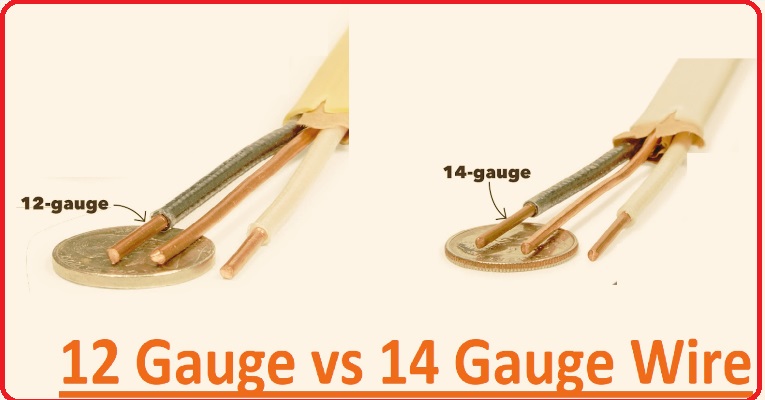
- 12-gauge wire is part of an electrical circuit because it provides high strength and precise dimensions. 12-gauge wire diameter is 2.05 mm.
- That thick compared to larger gauge wire, 12 wire construct for handling current properly.
- This wire comes with a larger cross-sectional area that reduces resistance and increases current.
- So they are part of circuits where high performance and durable installation are needed. This wire is rated for 20 amps and is preferred for high-load circuits. Low resistance with this thick design reduces voltage losses and is preferred for longer distance circuits.
What is 14 gauge wire?
- 14 gauge wire diameter is 1.63mm, and it is employed for short run circuits and has a thin strcuture compare to 12 gauge wire.
- It is part of lighting circuits and provides good capacity for a standard lighting system. 14 AWG gauge wire is commonly employed in outlets that support home electrical requirements efficiently.
Ampacity Ratings of 14 AWG
| Insulation Type / Temp Rating | Uses | Features |
| 60°C (140°F) | household circuits | used for lighting and light-duty outlet runs. |
| 75°C (167°F) | Damp locations in the conduit | High rating needed when devices terminals are for 75°C. |
| 90°C (194°F) | Conduit connections in dry or wet areas | Used for ampacity calculations, but still limited with the low device rating. |
| HF/XLPE Insulation | Long runs, higher heat environments | best for heat resistance and low friction compare to nylon-jacketed |
Breaker Sizes Used With 14 AWG
| Breaker Size | Features |
| 15 amps | It is a standard breaker usedin house wiring of 14 awg. that make wire safe |
| 20 ampsThe The | wire cannot manage this 20 amps current and has a chance of the breaker overheating. |
| 30 amps | for safe limits of 14 awg employed for heavy circuits and notfor this wire. |
| 10 amps | uncommon. used when a lower trip threshold is needed |
| 5–7 amps | low-load or control circuits. |
Types of 14 AWG Wire
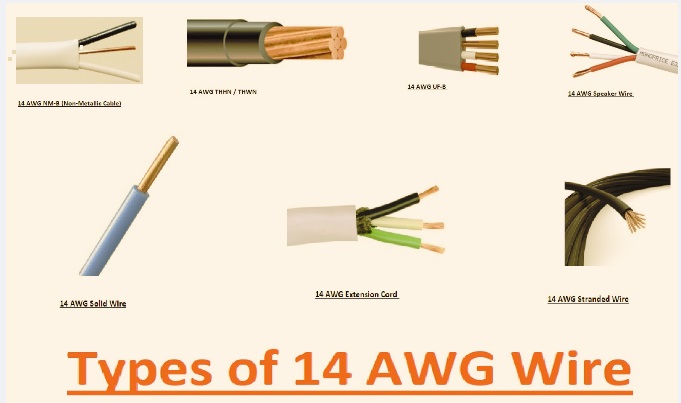
14 AWG NM-B (Non-Metallic Cable)
- It is a common type of wire that is used at homes. Its design is flat with a sheathed design having two or three conductors with bare ground. It is part of indoor circuits, such as lighting and small loads.
14 AWG THHN / THWN
- It is insulated conductors pulled through conductors. THHN is part of indoor circuits for dry locations, and THWN provides moisture resistance for wet locations. These two wires are high rating compared to NM-B.
14 AWG UF-B
- This cable is made for direct burial outdoor applications. it comes with a strong external jacket and is part of outdoor lighting and small structures, where conduit not used
14 AWG Speaker Wire
- it also used for doorbells, audio system circuits, low-voltage circuits, and thermostat wiring circuits
14 AWG Stranded Wire
- It comes with different thin strands compared to a single solid conductor. Its design is more flexible compared to solid 14 AWG wires and part of vehicles’ wiring tools, wiring, and marine
14 AWG Solid Wire
- Single conductor part for residential circuits, and its design helps to connect into terminals and staple over framing.
14 AWG Extension Cord
- It is used for light-duty extension cords and portable devices. These cords employ flexible stranded conductors and work well for different conditions according to jacket type.
12-Gauge Wire Amperage Rating
- 12-gauge wire carries a certain current that shows the amperage rating. NED details show this wire carries about 20 amps for 60 degrees, 25 amps for 75 degrees, and 30 amps for 90 degrees.
- For residential wiring, it carries 20 amps butcan manage high current.
- 12-gauge wire carries different currents according to some features.
- Voltage losses occurs for longer wires, high temperature condions reduces current handling features.
- It handles safe temperature through insulations like NM-B or THHN.
12-Gauge Wire Types
Different types of wire gauges are as
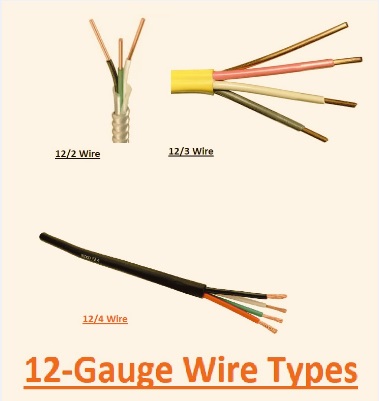
12/2 Wire
- The 12/2 wire comes with 2 insulated conductors, like one black wire and the other neutral wire with a green ground wire. This wire is used in 120-volt household circuits for lighting and outlets.
12/3 Wire
- 12/3 wire comes with 3 insulated conductors, like white, black red with ground wire. Extra conductors make it best for projects where multiway switching circuits are needed, also part of the 240V system where two live wires are required.
12/4 Wire
- It has 4 insulated conductors, like white, black, red, blue, and ground wire. 12/4 wire is used for complicated electrical circuits. It is also part of 3-way switching wiring and 4-way switching wiring, and 240V devices that use live wires and neutral.
| Wire Configuration | Ampacity | Conductors | Wire Temperature Rating | Maximum Length | Ampacity After Reduction |
| 12/2 | 20A | 2 insulated, 1 bare ground | 60°C to 75°C | 100 feet for 20A circuits | 20A |
| 12/3 | 20A | 3 insulated, 1 bare ground | 60°C to 75°C | 100 feet for 20A circuits | 20A |
| 12/4 | 20A | 4 insulated, 1 bare ground | 60°C to 75°C | 100 feet for 20A circuits | 16A (80% derating) |
Ampacity Ratings of 12 Gauge Wire
| Wire Configuration | Ampacity | Conductors | Wire Temperature Rating | Maximum Length | Ampacity After Reduction |
| 12/2 | 20A | 2 insulated, 1 bare ground | 60°C to 75°C | 100 feet for 20A circuits | 20A |
| 12/3 | 20A | 3 insulated, 1 bare ground | 60°C to 75°C | 100 feet for 20A circuits | 20A |
| 12/4 | 20A | 4 insulated, 1 bare ground | 60°C to 75°C | 100 feet for 20A circuits | 16A (80% derating) |
12 Gauge vs 14 Gauge: Differences
Diameter & Amperage Capacity
- Wire thickness and current-carrying features are the main factors for defining differences. The 12-gauge wire comes with a larger diameter and carries 20 amps without any damage.
- 14-gauge wires have a small diameter and a rating of 15 amps. So, 12-gauge wire connected with heavy devices like refrigerators and 14-gauge wire is configured with standard lighting circuits and electrical outlets.
Uses
- 12-gauge wire is used for circuits having heavy power requirements since it has a high ampere rating. such as parts of kitchens and bathrooms, where devices are using energy with high power.
- 14-gauge wire used for lighting. Its common example is that part for standard rooms where less power is used.
Safety and Code Compliance
- Wire gauge and circuit amperage compatibility are important for safety factors. The NEC defines that 12-gauge wire is used for 20-amp circuits and 15-amp circuits use 14-gauge wire. Improper gauge causes overheating, breaker tripping, and also fire.
Cost
- 12-gauge wire is high cost and high strength that carries high loads with less flexible design. that make difficult to connect in enclosed space. while 14-gauge wire is low-cost and easy to connect, so for demand projects.
| Feature | 12 AWG Wire | 14 AWG Wire |
| Diameter | 2.05 mm | 1.63 mm |
| Amperage Capacity | 20 amps | 15 amps |
| Circuit Breaker | 20-amp breaker | 15-amp breaker |
| Uses | Heavy-duty appliances, and air conditioners | Lighting circuits, outlets, and low-power devices |
| Cost | expensive | affordable |
| Flexibility | Less flexible, difficult install in closed spaces | Flexible, |
| Voltage Drop | Low voltage losses for long distances | High voltage losses over long distances |
| Preffered | high-power requirements, and future-proofing | low-power applications, budget-conscious projects |
12 gauge vs 14 gauge wire speaker wire
Cable Run Length
- 14 gauge awg solid preffered for short runs, about 50feet distance, and for longer distances more than 50 feet, 12 gauge wire is used since it has lower resistance, which is important for signal quality for longer distances
Power Handling
- Larger diameter 12 awg wire preffered for high power speaker since it reduces signal losses and manages high power levels.
- 14 gauge wire for low demandingin circuits manages standard power effectiveway
Audio Quality
- 12 gauge speaker wire best for high-performance features, gives quality sound and is part of high-end audio designs.
- 14 wire is best for maintaining quality audio for home systems and small projects.
Installation:
- 12-gauge speaker wire thick design that provides flexible difficulties and easy routing. while 14 gauge speaker wire easy to handle that provides easy connection for closed spaces
When to use 12 or 14 gauge wire?
Different factor involved for using 12 gauge or 14-gauge wire.
- The current capacity of the circuit is an important factor. 12-gauge wire has a 20-amp capacity, preferred for circuits giving power to larger devices and heavy machines. 14 gauge wire manages 15 amps
- wire run lenght and related voltage lossesalso main factor. 12 awg wire is used for longer cable runs since it has lower resistance, that provide required voltage level. In the short run, where the voltage is less than 14 gauge, wire is best to use.
- 14-gauge wire is low cost compared to 12-gauge wire, so best for small projects.
Conclusion
The basic difference between 14 AWG and 12 AWG wire is important for effective and reliable circuits and audio system operation. Both wires are part of homes and industrial loads, so choosing accurate gauges requires proper current loads, circuit lengths, types, and project requirements.
The National Electrical Code is also considered for accurate installations. 12 AWG wire has a 20 amp capacity and is best for different circuits in homes, like bathrooms, kitchens, and high-power devices. It has low resistance and is best for longer circuits where voltage loss is important. 14 AWG wire, 15 amp rating, low cost for lighting circuits, living area outlets, and low power circuits
Frequently Asked Question
What is the difference between 12 and 14-gauge wire?
- The basic difference is their thickness. 12 AWG wire comes with a high cross-sectional area compared to 14 AWG wire and carries high current. It makes 12 AWG wire for levels where high amperage is required and 14 AWG wire best for low-power projects.
When should I use 12-gauge and when 14-gauge wire?
- 12 gauge wire is used where high current loads used, like devices operating on 20 amps. 14-gauge wire is best for circuits where the current is not more than 15 amps and is best for lights and small devices.
Is 12 AWG wire preferred for longer runs?
- 12 AWG wire is best for longer runs than 14 AWG wire. Through a thick diameter, 12 AWG wire causes low voltage losses also for longer distances, and it delivers power to devices that are set at a distance from the electrical panel.
What is the rating for amps of 12 and 14 gauge wires?
- 20 amps rating of 12 AWG wire and 14 AWG wire has a 15 amp rating. These values are important for circuit breakers and wire confirmation, having required safety measures.
Can using a 14-gauge wire on a 20-amp breaker occur?
- No, it is not good to use 14-gauge wire for a 20-amp breaker. 14 AWG wire does not go far at 15 amps, and connecting to a 20 amp circuit causes overheating.
What advantages do stranded wires have over solid wires?
- Stranded wires of 12 or 14 gauge are flexible and easy to manage in confined spaces. while solid wire lasts longer and is part of a permanent structure. This feature is based on the installation environment.
What is the function of the gauge system in measuring wire sizes?
- 12 and 14 AWG wire gauge system shows the wire diameter. Low gauge means thick wire that carries high current. Such 12-gauge wire is thick compared to 14 gauge wire and has low resistance to current.